Showing posts with label recipes. Show all posts

Saturday, December 26, 2015

Let the glazing commence!


Glazed Carrots

Peel carrots and slice about 1/4-inch thick. Place in large, shallow skillet with enough to water just to cover. Add a generous pinch of salt and a good amount of butter. Bring to a simmer, and cook until carrots are easily pierced with a sharp knife. 

Remove carrots from pan with a slotted spoon, and continue to cook until liquid is reduced to a glaze. 


Remove from heat, return carrots to pan, mix to coat, and check seasoning. Serve immediately, or at room temperature (and this batch of leftovers was delicious in some shrimp/sausage fried wontons).

Monday, September 3, 2012

Best Bloody Mary Grows in the Garden

As today is the Labor Day holiday here in the U.S., I thought it fitting to begin the day with Labor (today: laundry and organizing) and then go for a pre-lunch Bloody Mary. Imagine my dismay when I realized that we had no Bloody Mary mix in the pantry. I did spy some V8 juice, but I'd much rather drink that plain than mix it with anything.
Garden Bloody Mary Mix
Looks delicious, doesn't it?
In general, I try to find the advantages of every situation so I told myself, "well, a V8 isn't really festive, but I guess all in all it's a healthy option," when I remembered that I have a freaking Kitchen Garden! I have an abundance of fresh tomatoes and herbs and such. Surely there is no need for me to go without my beverage of choice on this holiday. It's not exactly urban homesteading, but it's a nice degree of self-sufficiency.

I am glad I embarked upon this endeavor! And I strongly encourage you to try this. 

If you can make a smoothie, you can make your own Awesome Fresh Bloody Mary!


Make a Bloody Mary with fresh ingredients from your garden!
Here are my ingredients: fresh tomatoes (Super Sioux and Martino's Roma), fresh parsely, fresh basil, one fresh serrano pepper (most of seeds/pith removed) leftover chopped tomatoes/onions (in bowls) from last night's dinner, cucumber, juice from one lime, horseradish, worcestershire, salt, pepper. Lemon is for garnish. 

Chop tomatoes, cucumber and put in blender with other ingredients. Puree, taste, and adjust seasonings.

Now, some people may prefer to peel the tomatoes beforehand, but that is way too much trouble (and heat, and energy) for me. After pureeing, I just strained out the seeds/skin with a sieve, as described here. Seriously easy. The whole process, start to finish (including taking these pictures and two interruptions from children) was less than a half-hour.

Garden Bloody Mary is better than Zing Zang
Wow...could it be better than Zing Zang?
Becky's Bloody Mary Mix...I like the sound of it! The tiny chef inside said to put it in the fridge for an hour to let the flavors marry, but the tiny scientist inside wanted to try right away and an hour later to see if there was a difference. The tiny bacchanalian agreed with the scientist, so I went ahead and made an experiment.

The result is a Bloody Mary with a nice initial "kick" from the pepper and a nice depth of spice from the horseradish. I was pleasantly surprised by the sweetness from the fresh tomatoes. I loved the citrus and cucumber mixed in there -- very refreshing! As I suspected, the flavor was overall better on the second one. I also went low on the salt, with the plan of doing a salt-rimmed glass, but (as you can see) I forgot, so I ground a little sea salt right on top and let it "melt" into the beverage as I sipped. That was quite nice also.

Who needs a mix???  


Tuesday, August 9, 2011

Icebox Pickles: No heat required!

Icebox Pickles
No cooking required.
My last summer before college, I dated a fellow whose mother always had a bowl of what she called  "icebox pickles" in her refrigerator. She explained to me that it was perfect for summer because it required no heat, just mix and leave overnight in the fridge. Icebox Pickles take full advantage of a cucumber's natural crispiness and, as they're stored in the "icebox" (aka: the fridge), they're cool and refreshing in the heat of summer.

I'd never tasted anything like them before. I found my fork actually seeking out onions for the first time in my life; they were super-thin, just this side of raw, with a pickly-sweet crunch that perfectly complemented the cucumber.

This is a double batch, sliced super-thin with a mandolin, to give an idea of how much veg you need.
"Six medium cucumbers" is so very subjective!
A few years ago, I began trying to reproduce these unique pickles (with two unsuccessful attempts), when I found a recipe for "Marinated Pickles" on the recipe blog for my CSA, and suddenly I was in heaven. The recipe required no cooking, no heat -- cool and crunchy, all the way, so I adapted it to suit what I keep in my pantry/garden. Slice veggies thinly, toss it all together in a jar or bowl, and leave it in the fridge overnight. Easy, Fresh, Crisp. Summer!

Marinade (because it's technically not a brine if you don't boil it), before vigorous shaking.

The recipe is below, and calls for cucumbers and onions, but as you can see I added some green pepper and super-thin carrot. Use what you have.....

UPDATE, Summer 2018: After several years of experimentation, I have significantly reduced the amount of sugar from 1/4 cup to 1-1.5 TBSP. I kept cutting it and not finding a difference in flavor...until I went below 1 TBSP this year. Try this for yourself! See where your palate notices the change.

Click here for printable recipe.

Saturday, July 9, 2011

Kohlrabi: alien or spare baseball?

It almost looks squidlike, doesn't it?
Kohlrabi is a cool-looking vegetable, there's no denying it. I'd never tried it until last year when I opened up the farm box and thought "what the heck is that crazy thing and how on earth can I cook it?" I ended up cutting off the cool parts and tossing it with salt, pepper and olive oil and roasting it. I've not yet met the vegetable that didn't roast well. The verdict was "meh" from both myself and my husband. It is nice mixed in with roasted carrots or potatoes, but I wouldn't seek it out in the grocery store.

I should really like kohlrabi. It has a crisp texture not unlike a potato, but not starchy. It has a very mild flavor, reminiscent of celery or maybe broccoli. It sounds great but the reality is rather underwhelming. Lucky for me, I have a foodie cousin who is an accomplished cook. She advised me that kohlrabi makes a terrific spare baseball. Funny, eh? I remain undaunted for now and intend to give kohlrabi a few more chances to amaze me. I feel certain that there must a way to unleash the lovely, mild flavor in a way that makes me look forward to seeing it in my box each spring.

There was no way to make this look appetizing.
Sadly, my second preparation, this Kohlrabi Puree, was not the ticket. The incorporation of the stems/leaves really appealed to me. The flavor profile seemed right. But I didn't really care for it. It was not smooth enough for my taste -- a blender might have been a better option than the food processor -- but that's a lot of fuss for a flavor that is nice but not spectacular. I think perhaps a slaw is the way to go with this one.

I'm going to be getting it, so I might as well find a way I like to eat it. My husband remains skeptical that kohlrabi will ever achieve anything beyond "meh" for him.

Thursday, May 26, 2011

Chill Out

So if you've ever wondered "just how far south of Sunnybrook are you there, Becky?" I'll tell you I'm roughly 1,100 miles south of Maine (as the crow flies), smack dab in the middle of Tennessee, a beautiful and friendly place to live as long as you can appreciate a bit of heat and humidity. I grew up in West Tennessee (even more humid) in a house with one window a/c unit in the dining room that was only turned on for company. I've made my peace with humidity. 

Now yes, of course, I do use a/c, though I try to avoid it as much as possible because I hate being closed in where I'm insulated and can't even hear the rest of the world. Cool air in summer is a wonderful and amazing thing, but I wonder how much it accounts for kids playing outside less...for all of us being outside less, which means being less connected with the natural world. When I was a kid, it was often cooler outside once you hit the high 90s and I wouldn't be closed up in a muggy house for anything.


Cold-brewed green/mint teas
Whether I'm indoors or out, I like a little caffeine in the afternoons. In the winter, I enjoy coffee or tea, but in the summer I need something cold. I do really like iced coffee, but only really strong, freshly-brewed coffee and that's just too fussy for a quick afternoon beverage. 

Enter the cold-brewed green tea. Cold brewing renders a very smooth, drinkable tea and with no heating necessary, it's perfect for summer. Put tea bags in pitcher. Fill with water. Place in refrigerator overnight. Remove tea bags. Enjoy tea. I put five green tea bags and one mint tea bag in this batch and the result is smooth and intensely refreshing. 


Now, being indeed South of Sunnybrook, I have to agree with my friend Julie Ingrum, who knowingly asserts "there is only one way to properly sweeten tea and that is in the brewing process." I agree with her and when I make "Sweet Tea", even in summer I will brew it on the stove, but obviously you can't sweeten cold-brewed tea the same way. Now, I think the cold-brewed green tea is great straight and I drank it that way all last summer. But I'm hooked on something else now.

One day when my 4-year-old wasn't feeling well, we snuggled up on the couch and watched Laura Calder make this lovely citrus simple syrup on television. It's really easy to make and I add a bit to my green tea now. I can also make fresh, homemade lemonade on demand if I have some of this pretty simple syrup in my fridge and who doesn't love that? 

Citrus zest pretties up a sunny lemon simple syrup.
My sister adds thyme to her simple syrup and you can add other herbs (my friend Mary Alice adds mint and more in her delicious natural concoctions). I'm a lover of color myself, and I just really like the lovely bright yellow color this syrup gets from the lemon zest. It makes me happy to see it in my refrigerator. I can add herbage in my glass if I want some.

Try one or both of these this summer and let me know if you love this simple pleasure as much as I do.

Monday, May 2, 2011

Full-on American Food

When I was a kid, I heard someone explain how a hot dog was the perfect illustration of a quintessentially American food. You've got a sausage from Vienna, bread from the Midwest and condiments from across the globe. I liked the idea of food illustrating our melting pot, but really can't we offer up something better than a hot dog? If you say McDonalds I am now plugging my ears and running away screaming. I find it sad that most of the rest of the world thinks golden arches and Coca-Cola when they think of "American Food."

What is Real American Food? It's basically "peasant food." Real American Food is simple, fresh and easy to prepare. The thing that makes Real American Food unique is the surprising blend of flavors from around the globe.  I've worked in restaurants with some truly talented chefs. I've watched amazing chefs on television. They all say the same thing: get the freshest ingredients you can and cook it simply and you'll always have amazing food. I think it finally sank in when I started cooking with Alice Waters' The Art of Simple Food.


Tonight's dinner is Real American Food: Pork Chops with russet and sweet potatoes and Swiss chard. The pork, sweet potatoes and chard are all from a local farm with Avalon Acres. The russets came from Costco. Easy, breezy, simple meal.

Pork Chops with Potatoes and Greens
Season pork as early in the day as you can, but at least 30 minutes prior to cooking. I made up a rub with sea salt, pepper, chipotle powder, garlic powder, onion powder and a bit of brown sugar. You can season it the night before or in the morning and pull out of the fridge while you prep/cook other things. It needs some time to come to room temperature to cook evenly.

Slice potatoes and season lightly with salt and pepper. Brown in about 1/2 TBSP olive oil in skillet (they will not be fully cooked). Add chopped or sliced onions and garlic if you like. Remove from pan and add a bit of vegetable oil or bacon grease (just about a scant teaspoon or so). Brown pork chops on both sides. Add a cup or so of chicken or vegetable stock and scrape up the browned bits. Add back in the potatoes, cover and lower heat. Allow to simmer for about a half hour until the pork is cooked through and the potatoes are tender. Wash and roughly chop greens and add to pot; cook until tender (mine took about 5 more minutes).

I served this with homemade bread and some brown basmati rice since my children are hit-or-miss with eating potatoes. It's not fancy, but it sure is tasty.

Sunday, April 17, 2011

Pink Icing Without Food Coloring

What must a mother do when her child has an option for a big, fancy cake with cartoon characters and chooses a Mommy-made cake? Well, here "mommy made" means somehow making a chocolate cake "with pink frosting" that has no crazy dyes.

As primates, oh heck...as animals, we get a wealth of information from color. Color can tell us if a tomato is ripe or not. Color can tell us that the pear has gone south. Studies show that we respond to color even more than actual flavor, which is why the best chefs know you "taste" a dish with your eyes first...food appeals to all the senses.

Back before chemistry entered the mix, food was colored only with natural dyes. Depending where you lived (and the season), you might use beets, turmeric, blueberries, flower petals...things like that. In modern times, food dyes are often bright and appealing and also often dangerous. It's hard to be a parent these days without at least hearing of the many ills associated with artificial food dyes, especially the very-common FD&C Red 40.  Almost everyone knows least one other parent who swears it turns their otherwise normal child into a little demon from the ninth level of Hades.

All that said, I don't generally disallow a treat just because it has some artificial dye. If a friend offers Skittles or M&Ms I will probably indulge and allow my kids to do the same. I even make Strawberry Jello at least once a year, though I am planning to use Mary Jane's ChillOver (vegan!) from here on out, so some red icing on a cake is no big deal, right?

Well, it's one thing to buy it or accept it and another to willingly and purposefully inject this stuff into something your child has requested.  Enter the googletubes: how do you make pink icing without food coloring?

I found several suggestions for raspberries and strawberries, along with admissions that the color was quite weak. Finally I settled upon trying dried hibiscus and beet root powder. I've taken some pictures to show the difference.

Here is the "pink" hibiscus butter mixed with sugar. My butter looked quite pink after simmering and straining. It was dotted with pink after cooling, and a lovely pink after it warmed back up and I stirred it. But when mixed with sugar, the pink was barely visible. It was a lot of work with no visible result.


Inclusion of beet root powder changes all! I added some cream cheese to my hibiscus butter/sugar mix to even out the already-pasty color (just in case, then added 1 TBSP beet root powder. I was impressed! The picture here shows a pink plastic cup to help gauge the pinkness that first TBSP. More powder = more pink. Yes, at this point I did realize it was just as easy as simply adding red food coloring! I was still nervous about possible flavor issues, so made juice from smushed strawberries and added that to thin the icing vs.using water or milk. I tasted with/without and it really doesn't matter, but the berries add a lovely, juicy note to the icing, so I consider them well worth the minimal trouble invested.

Here's the final result. It looks very pink and tastes even better. Pinkalicious!!


Thursday, January 20, 2011

Pancakes for Dinner

Because it's easy, quick, can be made sweet or savory, and fun to make with your kids.

Easy Buttermilk Pancakes

Ingredients
2 cups all-purpose flour -- I use 1/2 unbleached white and 1/2 white wheat. Feel free to add a Tbsp. or so of flax meal, or tweak to suit your tastes.
2 teaspoons baking powder
1 teaspoon baking soda
1/2 teaspoon salt
2 large eggs, lightly beaten
3 cups buttermilk
4 tablespoons unsalted butter, melted

Extras
Fruity: 1 ripe banana, mashed; 1/4 cup applesauce; 1-2 TBSP low-sugar preserves; cinnamon (to taste)
Sweet: Chocolate chips and nuts
Savory: 1 shredded carrot and/or zucchini (squeeze out water before adding); 1/4 cup Parmesan cheese

Directions
Heat griddle to 375 degrees. Whisk together flour, baking powder, baking soda, and salt in a medium bowl. Add eggs, buttermilk, and 4 tablespoons butter; whisk to combine. Batter should have small to medium lumps. Add "extras" and mix to combine.

Grease griddle. I prefer bacon grease (just a touch), but you can use butter or cooking spray. Pour batter on griddle in the size you want and cook until pancakes have bubbles on top and are slightly dry around edges, then flip over. Cook until golden on bottom, about 1 minute.

Serve warm with applesauce. For sweet/fruity pancakes add maple syrup; for savory pancakes try a little sour cream and chives on top.

Monday, January 17, 2011

A half-gallon of yogurt is too much!

Peach yogurt made with plain yogurt and Amish preserves.
About a year ago, I happened upon a few intrepid bloggers who had successfully made yogurt at home...in the crock pot.  This idea appealed to me immediately because it meant I did not have to buy a specialized appliance. So, I tried it and it really worked!  The only problem is that a half-gallon of milk makes a half-gallon of yogurt, which is an awful lot to eat in 7-10 days.

Even though I strain half of it to make "yogurt cheese" (can be used as a sour cream substitute), I was still tossing a lot of it.  I'm all for making all-natural, preservative-free, HFCS-free food, but it pains me to throw away food.  It feels actively ungrateful.  So, since I loved the homemade yogurt, I had to make about half as much.

Finally, I bit the bullet and purchased a small, 1.5-quart crock pot to make a smaller batch.  Yes, I realize that I went out and bought an appliance *just* to make yogurt, but at least it can be used for other things.  Incidentally, while reading the reviews, I realized I could also use this to make oatmeal/hot cereals overnight, so if anyone has a wonderful oatmeal/quinoa breakfast, please let me know. 

With the smaller crock, I had to tweak the timing slightly because it heats differently, but basically the milk needs to heat up to 180 (without boiling) and then down to about 112. You can either use a freeze-dried starter or some yogurt with active cultures, either from a batch you've already made or just some Dannon or Stonyfield organic -- as long as it says "with active, live cultures" it will work.  I have used both, but keep some Yogourmet on hand in case we've eaten up all the yogurt.  There will be no further mention of yogurt being allowed to spoil!

Yogurt is easy.  Pour one quart of milk (that's four cups) into the small crock.  One of these days I'm going to start using liters and grams and see if anyone notices.  Turn it on Low for 3 hours, then unplug and turn off for 2 hours.  Remove about a half-cup of milk to mix with your starter.  The Yogourmet is premeasured for one quart.  If using yogurt, use about 1/4 cup.  Whisk those together well, then add back into the crock and whisk well.  Cover and let sit at least 4-5 hours, or overnight.  I did cover the crock with a towel, but I'm not sure it's necessary; I won't use it in the summer.  After it's thickened, refrigerate until cold, then pour off any whey.  If you like, you can further strain with a cheesecloth-lined sieve for a thicker yogurt.  You can also add some powdered milk when you add the starter for a thicker end product.  Experiment!


Line a mesh strainer with cheesecloth, add yogurt and fold remaining cloth gently over the top.  Let sit in fridge for a few hours or overnight and enjoy a thick, Greek-style yogurt that is hard to differentiate from sour cream.
I like to make this in the morning so I can put it into the fridge before bed.  If you're out of the house all day, you can certainly start it when you get home and add the starter before heading to bed...just remember to pop it into the fridge before you leave the next day.

I prefer low-sugar preserves to flavor/sweeten.  Trader Joe's has a great selection and Costco also offers an organic strawberry preserves with only 8g of sugar per tablespoon.  Vanilla is also a popular option.  If it's not sweet enough, I find that agave nectar mixes very easily with the yogurt.  Honey tends to solidify and sugar remains grainy.  

I haven't gone so far as to break down the "cost per portion," because Stephanie already did it! Making organic yogurt was $.02 per portion vs. $.27 per portion for YoBaby....that means YoBaby is almost 15 times more expensive than homemade and you can make it lactose, casein, dairy, soy, gluten, and any other allergen free.

Friday, January 14, 2011

Ruthlessly Purge Your Cookbook

Everyone should have a collection of "Tried and True Recipes"
It's funny how your favorite "go to" recipes can change.  I finally started my own recipe collection a few years ago and it had literally exploded out of its binder of late, despite repeated applications of duct tape.  I had been putting off purging and reorganizing because I couldn't find a replacement binder.  Mine has a little flap on the front that makes it easy to change the "cover page" and I use that to place the recipe I'm using so it doesn't get splatters or spills on it. After approximately two years of fruitless searches in various office supply stores, I remembered that we live in the Age of the Internet and found an exact replacement at Amazon.com.

Wilson-Jones "Smart View" Binder
The last time I reorganized my recipes was four years ago when I recognized a need to move away  from the time-intensive, fancy (and costly) meals that were a hallmark of our days as Childless Newlyweds. Ah memories of Friday nights with courses and cocktails! That first cookbook was organized primarily by main protein (Pork, Chicken, Beef, Fish, Vegetarian) and I don't search for meal ideas that way anymore.  Instead of looking for recipe ideas and then buying ingredients, I tend to look at what we have on hand and what we've gotten from our CSA and create meal plans around that.


I love making piles.

So, I pulled out my recipes and began to sort them into eight piles, grouping together things that seemed most alike and  tossing anything I hadn't made recently or didn't care to make any more.  A lot of recipes including "cream of" went into the recycle bin!  I continued to reshuffle things until I had eight piles that were roughly the same size.  I ended up with Soup, Veggie Main Dishes, Easy Meat/Slow Cook, Breads & Muffins, Summer, Winter, Apps & Desserts, and Holiday & Gifts.


Use Scotch tape to easily change categories when the need arises.
See that duct tape holding the old book together?  I should have taken a picture of the front -- it was more duct tape than binder.  One bit of foresight I had when I began my own Recipe Binder was to put a bit of Scotch tape on the main category page.  When changing categories I didn't have to toss the fully functional divider pages; instead I just pulled off the tape, put some new on there and wrote in new categories.

The interior pockets are used for the few recipes I have printed on cards that I'm too lazy to re-type and for recipes that I want to try but haven't yet.  Take a look at your own favorite recipes.  If the book is too full of things that are too complicated or have the wrong ingredients, you'll never use it.  Purge and organize to make it an easily-accessed source of inspiration for healthy and tasty meals!

Thursday, December 23, 2010

Coconut Cake, like Gramma used to make!

My gramma made the most amazing coconut cake.  Light cake in thin layers almost (but not quite) dripping with a soft coconut moisture and a delicate icing that formed a crust on the outside...it always reminded me of the rare West Tennessee "sticking" snow on the first morning after it fell: dry and light with a thin layer of sleet on the top that crunched softly when your foot broke through.

My gramma, Marvene Tucker, made this cake at least once a year (sometimes twice), for a big family get-together, usually Christmas.  She was a lady who could take a bit of this and a touch of that and turn it into something not just palatable, but delicious.  She and my Grandpa Leon were farmers who made do with what they had and made it good.  But this cake, this Coconut Layer Cake, was a masterpiece worthy of the finest table.  It was beautiful to look upon, with its pure white towering goodness softly mottled with mounds of fresh coconut.  But it was even better to eat.

Two years ago, I decided to make a coconut cake for my dad for his birthday.  I tried tracking down the recipe from my dad's sisters but no one could remember the specifics since gramma never used a written recipe.  My mom recalled a "boiled icing of some sort."  For once, the intertubes were no help at all.  Recipe after recipe called for cream cheese or sweetened coconut or canned this or that.  I was at a loss and finally hit upon the brilliant idea of asking my neighbor, a True Southern Cook if ever I've met one.  My description of the icing hit home and Charlyn immediately said, "oh, that's Seven Minute Icing."  The cake is another story.  That year, I used a boxed white cake mix and moistened it with canned coconut "milk" and was forced to top the whole thing with sweetened coconut because I couldn't find unsweetened anywhere.

My dad, God love him, appreciated the effort.  And that cake was tasty.  But it wasn't THE cake.  When pressed, Dad noted how sweet the coconut tasted.  Yeah, I noticed it too.  I know Gramma only and ever used real coconut and somehow turned that into this cake, but had no clue how it worked until my husband caught an Alton Brown show about making an "old-fashioned" coconut cake.  Armed with this link and my memories (and parents' memories) of gramma's process, I pressed onward to coconutty delight.  I consider it part of my heritage, after all!


My dad with his authentic, totally from-scratch, like-mama-used-to-make Coconut Cake.

First of all, let me warn you that this cake is delicious.  Truly, truly delicious.  It is also a lot of work.  I did it over three days, which is a great way to tackle a project like this when you are unable to spend an entire day baking a cake.  Since you have the recipe already via my Alton Brown/Food Network link, I'll just note the things I did differently or found interesting enough to photograph.

Day One: Break down coconuts.  Make coconut cream, coconut milk.  
Day Two: Make Cake, soak with coconut water.
Day of service: Make icing, frost cake, refrigerate!

Per my husband's suggestion, I used a drill to make three holes in the coconut to access the coconut water.  This picture shows one coconut still with the hard shell and one (on the right) with the thin, brown "undershell."
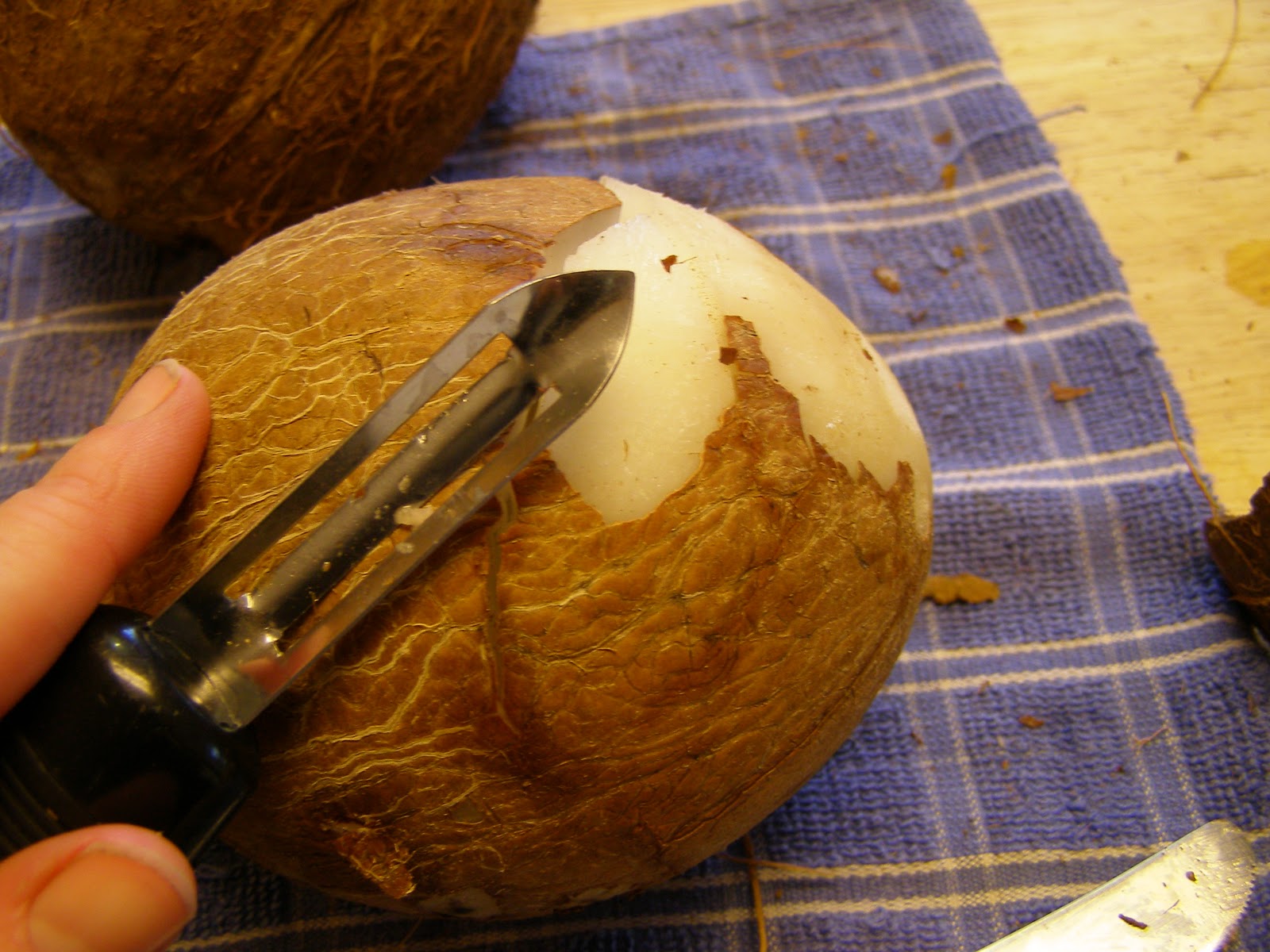
Alton Brown recommends using a serrated vegetable peeler, which I do not have.  The regular peeler worked just fine for me.
Coconut freed from the shell, ready to be rinsed.

Now, here I'll note that I followed the directions on the link to make coconut milk and coconut cream.  However, I later watched the actual Alton Brown episode and really like the method he uses in his show better.  It's a little fussier really, but if you're going all out, then go all out, right?

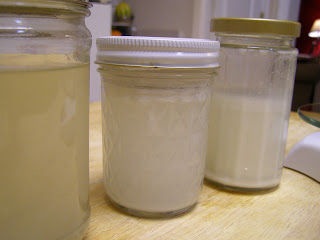
From l-r: coconut water, coconut milk, coconut cream
Frugal tip here: clean and save a few smallish jars.  They work much better for storing liquids, like sauces or stock, than a square saver.  They're nice to have around to mix up a vinaigrette without dirtying the blender.  I don't have many...I try to edit so I don't become a hoarder.  I probably have 5-6 jars in a 3-cup and under capacity and they come in handy frequently.  I can use Mason Jars for anything with more volume.

Day Two: Make Cake

My way to cut parchment to fit -- I made a line in the corner with my fingernail.  Alton has a neat technique but mine works just fine.
See?  Perfect circle for cutting.

Finished pans await batter.

Learn to get out and, if convenient, measure all ingredients before beginning.  Trust me, it makes it soooo much easier.  And then you never have to hunt for something with egg on your hands or realize to your horror that you don't have the very last ingredient you need.

I do not own a stand mixer. I'm sure it would be nice to have one, but I really don't have the space for it right now anyway.  I just mix a little higher speed and a little longer with my hand-me-down hand mixer.  Just like June Dye says, it comes out just fine.

This is what I consider to be "stiff peaks."  I add the egg whites to the batter in thirds, folding carefully each time.

Again, Alton has a neat way of cutting the cake evenly (this is why I sought out the video on the first place).  Unfortunately for me, my cooling rack did not fit into any rimmed pan I own, so I was forced to eyeball it.  This is fine; just be sure to try to assemble it so that the short sides butt up to the longer sides.

Four layers ready. 
Here I must share an important deviation from Alton Brown and his wussy spritzer bottle.  I love Alton Brown, truly, but a spray bottle?  No way!  A real coconut cake (like my gramma made) is almost dripping with moisture.  I used three coconuts and procured quite a bit of coconut water, so I reserved 1/3 cup to make the icing, leaving me with 1 1/4 cups coconut water.  After making the cake, I had some milk  and some cream remaining.  I mixed this all together and brushed it ALL over the cake.  Then I froze it.

Here's my freezer setup: cake layers separated by wax paper and wrapped tightly in plastic wrap. 
Theoretically, you could make this several days before.  Just be sure to pull it out of the freezer with plenty of time to defrost (if serving for dinner, put in the refrigerator the day before or that morning).

Serving Day!

Making icing.  Again, all ingredients are assembled beforehand.  Please don't skip this step!!  It makes cooking so much more fun, especially if you are doing it with children around.
Have a discriminating critic taste-test the icing to be sure it is acceptable.

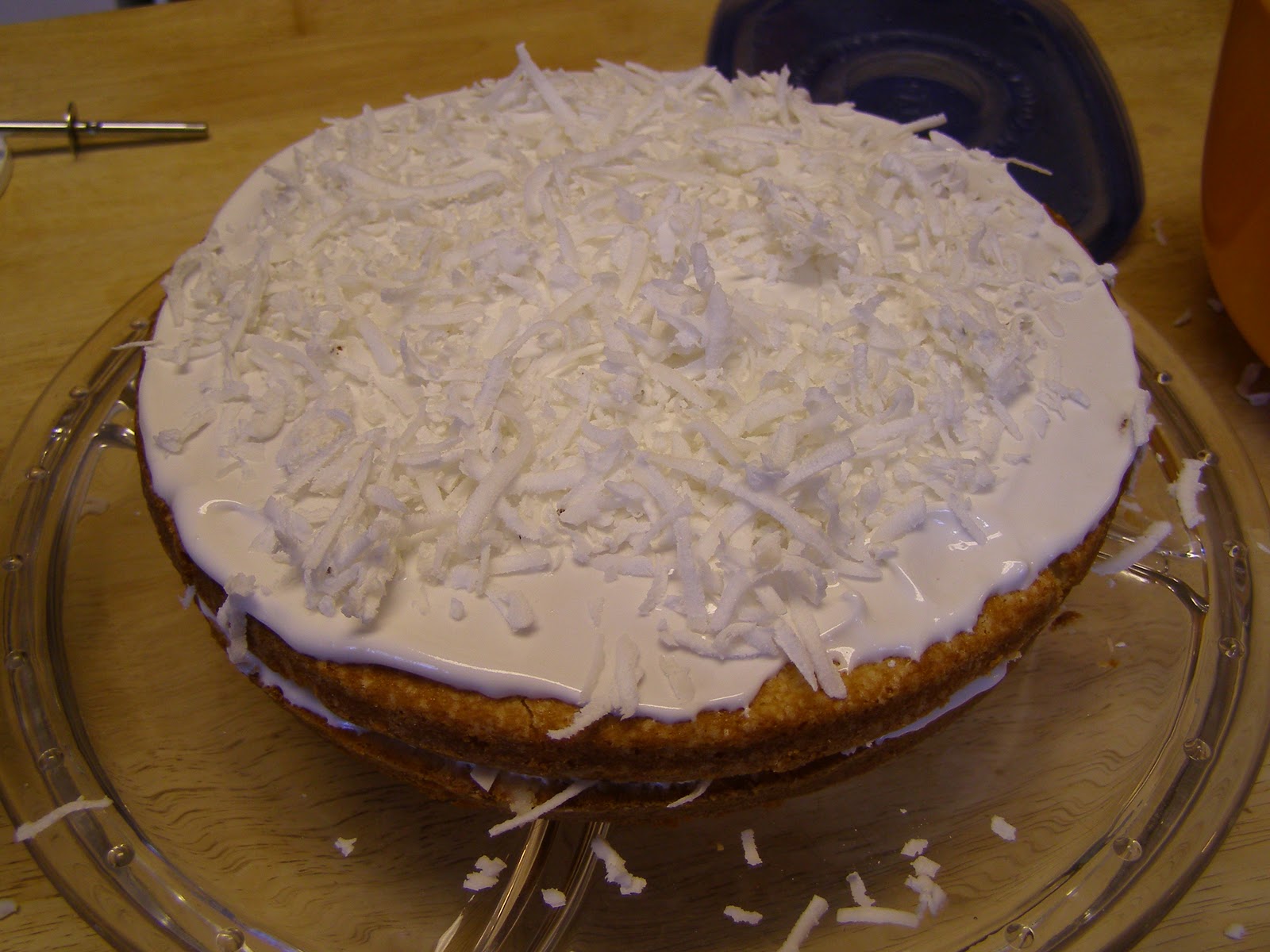
Ice the cake, alternating icing and coconut.  This icing does tend to be a little runny, so having cold layers helps keep everything where you want it.  Do not be afraid to secure the layers with a toothpick here or there; just try to keep count of how many toothpicks you use so you can remove them before serving to toddlers.
This came out wonderfully!  After eating it, my dad requested another for Christmas because, after all, that was his mother's tradition and if I wanted to be true to tradition then it was obvious.....

When I stopped laughing, I reminded him that she didn't make this masterpiece only a few weeks apart.  Since half of the cake was left, he recommended freezing it "like she used to" and we'd have it after our Christmas fondue.  Aha!  That was the freezing I remembered; however I like freezing the layers after soaking them and think it makes for a softer cake due to the freezing/thawing process.  If you wanted to just refrigerate, that would probably be fine too.  

I'll update in a few days to let you know how the cake makes it after a few weeks in the freezer.

Update: The second half of the cake froze beautifully and tasted great several weeks later. It actually reminded me more of my grandma's cake because she'd do that with her leftover cake. She'd often transfer it from the freezer to the fridge in the morning if she expected us to visit in the afternoon and sometimes the cake was still slightly frozen in the middle. It's definitely a bonus to freeze part when you make a cake requiring this much labor (speaking as a fairly basic baker here).

Tuesday, December 14, 2010

Garlic Bread


Homemade garlic bread

I've been making No-knead Artisan Bread for a while now and really love having homemade wheat bread at the dinner table.  The only problem with the artisan bread is that I can't make it at the last minute.  If I've got dough in the fridge, no problem, but if I haven't mixed some up yet and it's 4 p.m., then I'm out of luck for dinner.  


Finished loaf
Enter Messy Mommy's Basic Bread Dough!  This is a soft bread dough that I imagine would be easy to use to make rolls.  I made a full loaf and used 1 cup unbleached white flour, 1 cup white whole wheat flour and 1/2 cup whole wheat flour.  And...it makes lovely garlic bread.  For my garlic bread, I first slice the loaf almost, but not quite, through.  Then mince a few cloves of garlic and simmer it gently in a few tablespoons of olive oil.  Use a fork to mix this with a few tablespoons of butter (mashing well) and slather it over the sliced bread.  Wrap in foil and bake in a 350-degree oven until everything is melted and the garlic bits on the top begin to toast.

Tonight, I made a half loaf (cut the recipe in half) to go with the carrot soup.  It was wonderful!  The more I try different breads, the less I want a bread machine.  

Tag Cloud

Make Your Own simplify Easy garden Inside My Fridge Living on Less recipes food frugal Live Well meal plan Tennessee Edible Landscaping Kitchen Garden organic Garden Tour Spring flowers Real American Food Use It All change vegetables Dinner Grow Your Own grow tomatoes Life Love Summer greens kids Family dinner recipes explore gift seeds Companion Plants Lettuce Reality Sink Saving Seeds bread freezer garlic squash Fall Inspiration Special Try It and See emotion moderation planting quick reduce Art Artisan Bread Beauty CSA Celebrations Cool Beverages Cucumber Experiment Featured Flood Sheet Mulch Small Changes Tea craft fruit reuse soup stock waste yogurt "sometimes food" Amaryllis Becky's Favorite Things Bloody Mary Blueberries Books Cabbage Chard Connections Date Night Edible Flowers Family Dinner Jacob's Ladder Lint No-till Organize Read Real Life TN Native Plant Trash Day Use the Oven Winter black-eyed susan chicken crock pot daily reminder essential oil garden pests kale leftovers permaculture plastic pork potatoes recycle rudbeckia seedling stir-fry strawberries swale trash vegetarian volunteer A-frame Authentic Authentic2 Bacon Baking Fail Better Homemade Body Balm Breakfast Build Soil Butter Carrots Chives Chocolate Milk Chocolate Syrup Christmas Clean Cookbook Review Crock Pot Bread Eat Local Faith Fire Cider Food as Medicine GM foods GMO Ginger HFCS Health Holy Honeysuckle Hot Cocoa Household cleaner Hydrangea Icebox Pickles Iced Mocha Immune Booster Iris Kitchen Sink Lent Life Notes Monsanto Morning Sink My Neighbor's Garden Pickles Placating with Plating PlantEaters Propagating Geraniums Sacred Salvia Leucantha School Lunch Sewing Slow Cooker Bread Slow Cooker Fail Spiderwort Spinach Spiritual Practice Spring roll Sprouts Thanksgiving Time-saving Tips Tincture Turkey Turmeric Victory Garden Vodka Water Kefir What Chefs Feed Their Kids basil bento berm birthday borage brassica broccoli cabbage worm cake canned tomatoes chili coconut compost dessert discipline eggplant eggplant parmesan fennel flour food waste frosting gluten green beans greenhouse grocery healthy hair healthy scalp hornworm hugelkultur icing knead kneading kohlrabi landfill lasagna garden nasturtium natural hair wash no poo pancakes parsley patience pests pizza plantain potager processed sangria seed pot smoothie standing desk substitute for dill tarragon teacher appreciation teacher gift vegan water window crayons yeast

Eat Locally!