Showing posts with label Kitchen Garden. Show all posts

Tuesday, June 14, 2016

Glory of the June Garden

Instead of watering daily, I've switched over to watering only every 2-3 days, but watering very deeply, which encourages deeper root growth, requiring overall less time and less water!

This morning as I watered and observed, I was overwhelmed by the amazing beauty and life in my garden. My hard work of the last few years is beginning to pay off in food, and knowledge, and a wonderful appreciation for the interconnected web of life.

Narrowleaf Plantain


Bean Blooms


Magnolia

Lovely Gladiolas

Serrano and Thai Chile

Super Sioux


I netted the berries this year! 


Zucchini


Beet Harvest

Monday, September 21, 2015

Maximizing water on slopes: berms, swales, and countour

My Master Plan to plant my full-sun real estate (aka "the front yard") continues this fall....I learn by doing, so I tend to go do something and then revise it based on what I've learned. Several years ago, I build a sheet-mulch bed on the side of the house, which has done well, especially after I added a few berms to control water. I've been reading up on permaculture design over the last year or so, and plan to change that layout of that bed this fall to dig some swales/paths "on contour" for the permanent design.

In the front part of the yard, I built a circle bed two years ago, which is a nice feature. The first year, I planted it with Scarlet Runner Beans (growing up a "tepee"), which the kids loved. The second year, I put all my tomatoes there, and this summer, I had beans, chives, flowers, and an artichoke that grows well but hasn't bloomed.

Last winter, I saw this great idea in Mother Earth News to use straw bales and old windows to make some cold frames, so I plunked some down on my hillside to see if it would work. It did!
Cold frames with straw bales and old windows protected plants from several days of single-digit temps (Middle TN).
Once spring arrived, I put the windows away, added some compost, and planted the area with tomatoes, herbs, peppers, eggplants, and flowers. I was very pleased with this new "bed" area. It runs right next to a natural (and well-traveled) path, but I wanted to expand it for the next growing season.

Enter the simple A-frame, which is a great tool for figuring out where the natural contours of your hillside fall. I used a level with mine, but this video uses a plumb bob...it's short and explains how to do it if you're interested.

The "well-traveled natural path" is not  on contour, but I'm hoping to build/move my beds to intersect it. Today I dug out a swale, and I'm posing this to share my process and to get feedback!

Here is a longer view from the same angle as the "cold frame" picture above.
plans berm swale
Envisioning the future....

The green lines on the left show one side of the natural path -- I planted the border with some liriope (monkey grass) that I got from a friend this spring. I'll mulch the area to the side of it well, and plan to add creeping phlox and possible some perennials, though the Magnolia tree does offer quite a bit of shade. The orange area shows one side of my "cold frame" hay bales, and I plan to make this my path border....I have plenty of large limestone rocks I can use to set the path border.

Intersecting with the path, you can see the swale I've dug, which is on contour. I have some hay bales out right now to kill the grass and hold the berm. The plan is to build a small wall in spring (purple lines), using stone pavers that match my circle bed. I can build another berm/swale bed (lower purple line) next spring or fall, depending on my time.

Here is the swale (so far) from the opposite side:
The swale is about one foot deep right now, and about 1.5 feet across (maybe slightly less). I plan to make it a little wider/deeper, and fill it in with small rocks/mulch to make a permanent path. The top "triangle" portion of the bed will be planted with perennials/herbs.


And here's one more view, from the perspective of the middle circle garden. Next spring, instead of hay bales, we'll have a low wall of matching pavers. (Also, you can seem my awesome hugulkultur bed in the background.)
I'm planning to plant the berm in some kind of cover crop this fall, and will use some low row covers for winter planting in the old "cold frame" beds. I had great luck with all my herbs/veggies there this summer, so I have high hopes for winter gardening!

What do you think?


Tuesday, June 3, 2014

Joyous Southern Spring: Garden Tour May/June 2014

Peas in garden
Peas
After the longest, coldest, loneliest winter in a long time, Spring has been truly welcome here South of Sunnybrook. I started lettuces from seed, but got most of my peas in later because of all the late freezes. Lesson learned: plant peas anyway, most of them will survive if they're mulched. Plus, pea seeds are cheap (I plan to save some this year also)!

Garden harvest - strawberries, spinach, oregano, lettuces
Harvest
Spinach, basil, strawberries, and lots of lettuces (like the ones in my Teacher Appreciation bouquets) have been devoured by the family. We've been listening together in the car to the audiobook Animal, Vegetable, Miracle: A Year of Food Life (which is the book that first inspired me to try cheesemaking and join a CSA), and I think it's inspired appreciation in my children. It is truly wonderful to hear them go on and on about how "nothing tastes so wonderful as a good, fresh strawberry you pick yourself."
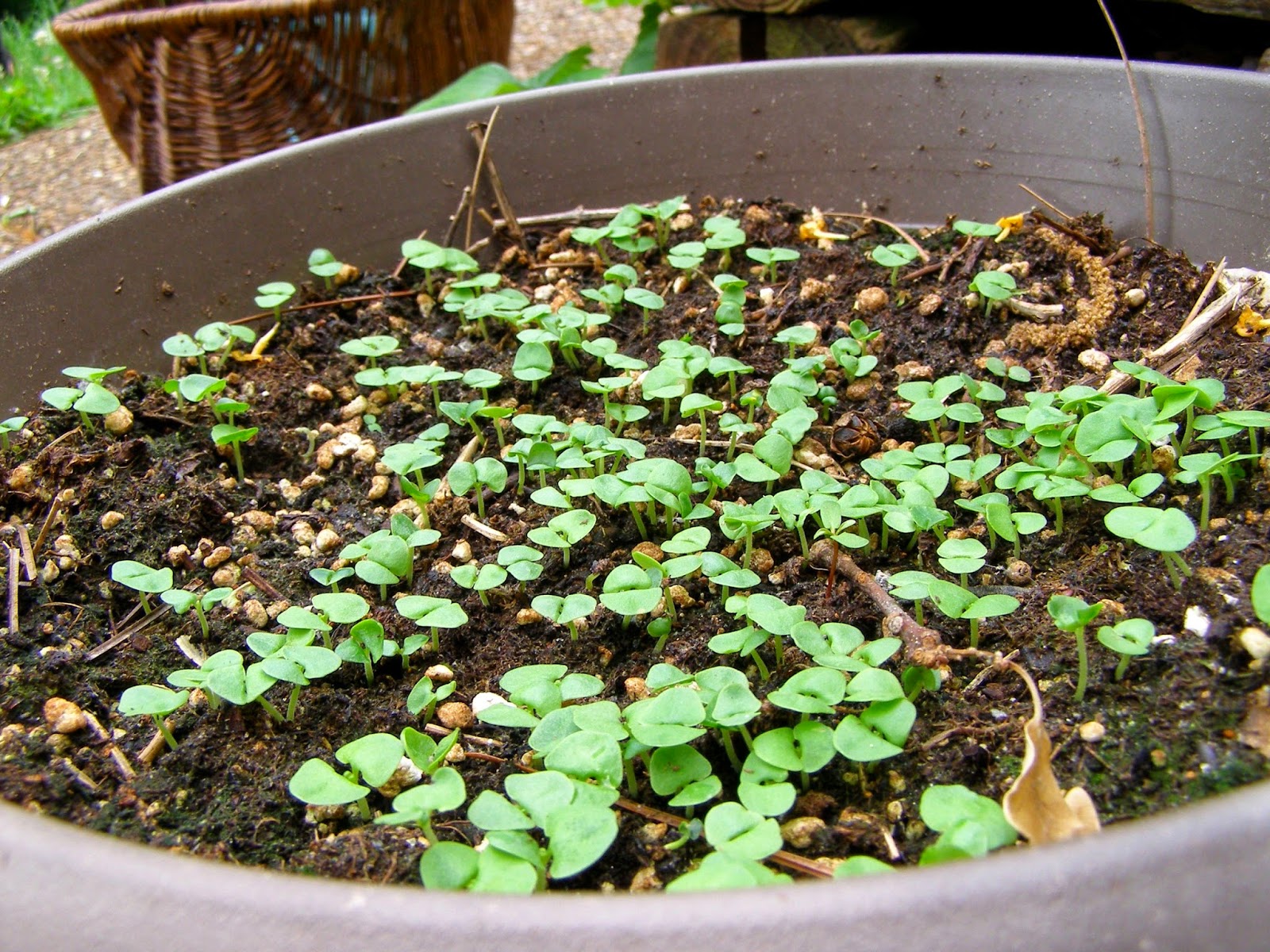
Basil Seedling Nursery
Baby Basil
For the last two years, I've planned to start various herbs, veggies, and flowers throughout the summer, so as to have filler for bare spots as I harvest, and to have lots of sets for fall veggies (which need to be planted in September-ish). I never do it though. In January, making paper pots filled with earth and seed is like planting hope, but in July I don't want to sit at the table...there is too much to do outside. 

So I am starting things in large pots, like the basil above, and will thin them and move them to the garden. I also have some German Chamomile and chives started this way, and plan to keep things growing throughout the summer.
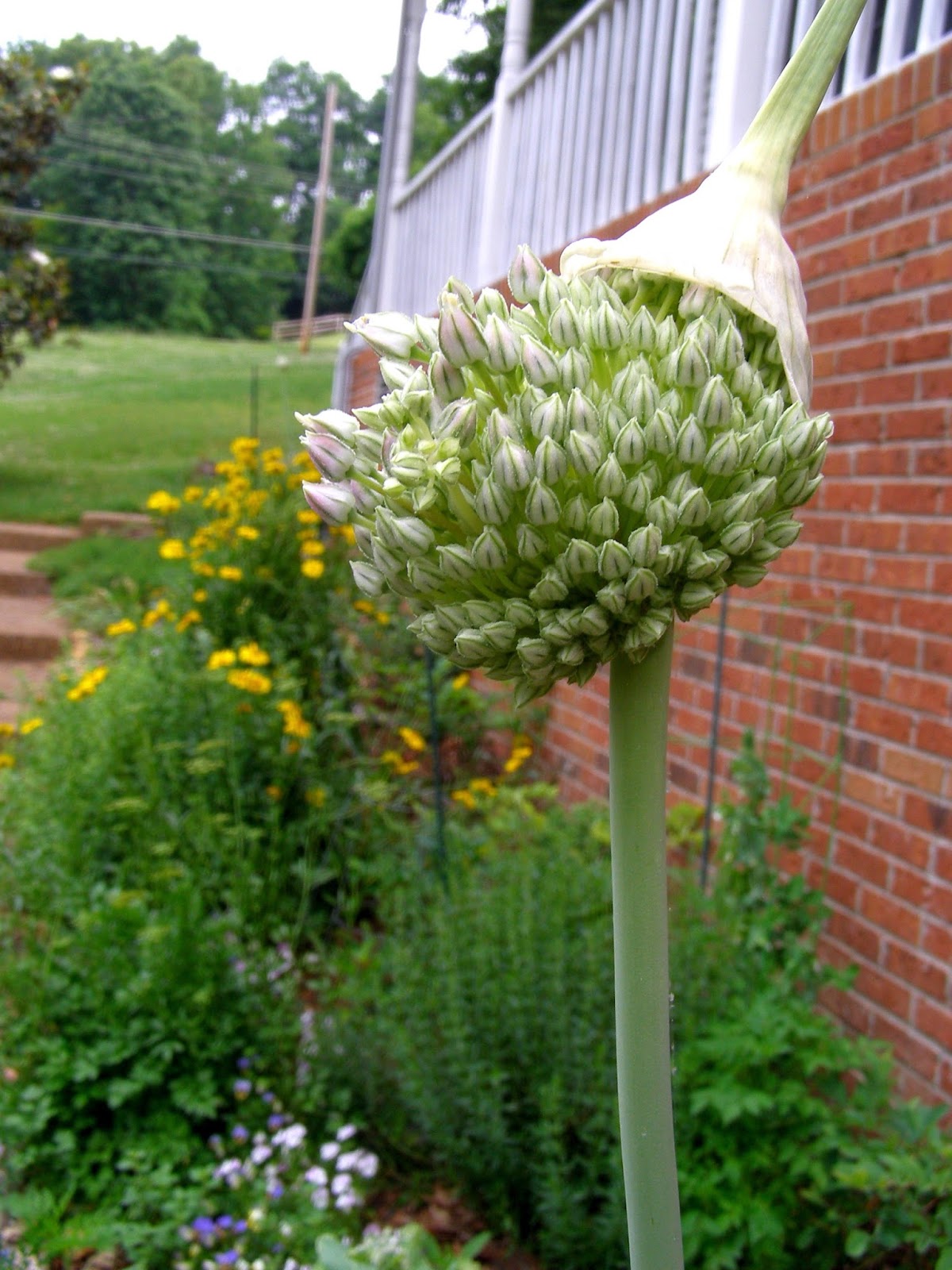
Garlic Flower Hat
Garlic Hat
This is my first year planting garlic. I got some Red Russian seeds from the Seed Sharing program at my local library (how cool is that??), and a few cloves of a different hardneck variety from my father. I am going to try harvesting some seeds from the flower this year. I did cut one of these flowers and fried it up along with some stuffed squash blossoms, and it was delicious! Experiment!
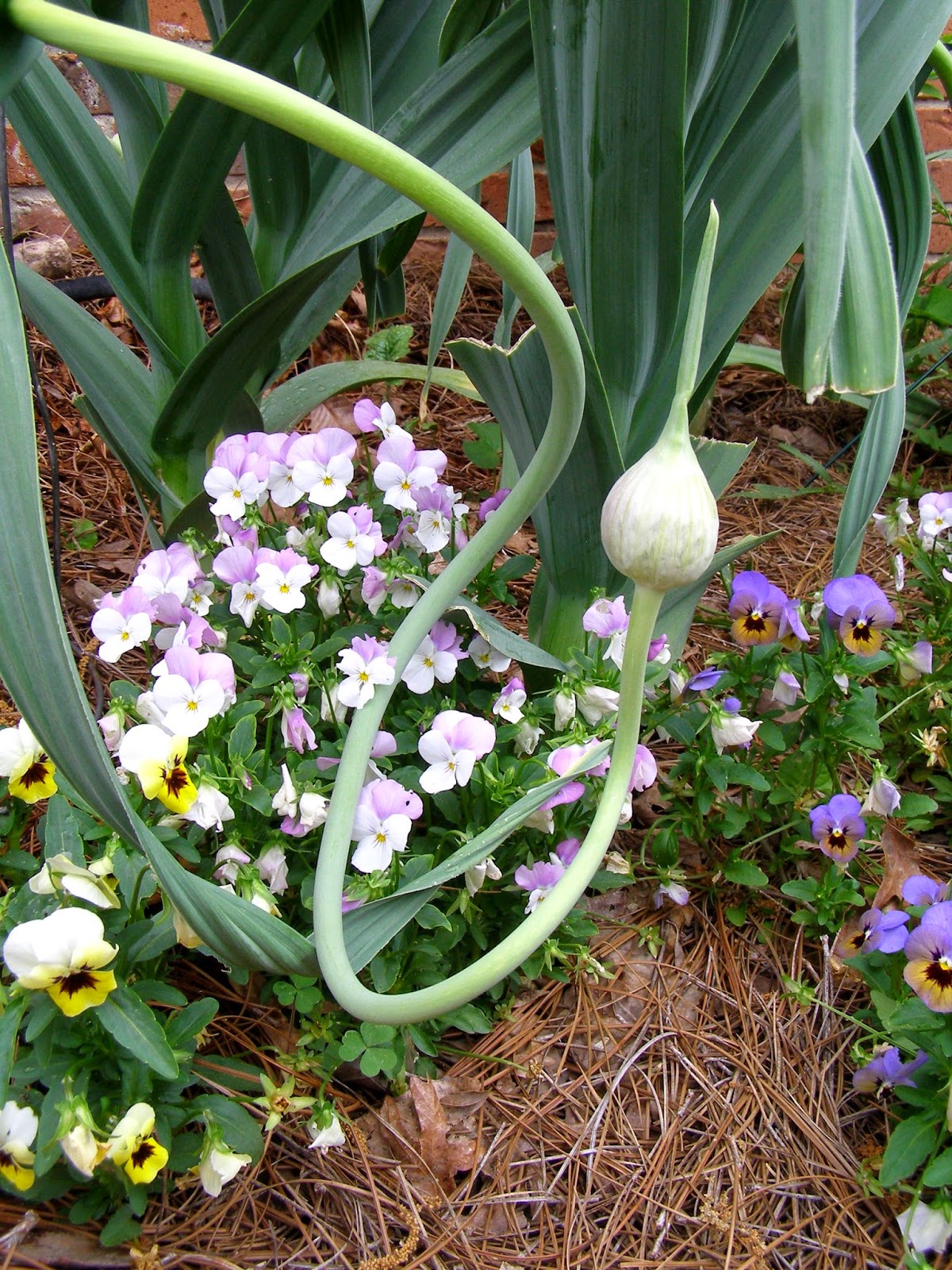
Garlic Scape
Scape
Garlic is a beautiful addition to edible landscaping. The scapes (or long stalks that hold the flower) can curve around into wonderful shapes that are very pleasing to the eye. For hardneck garlic, there seems to be a difference of opinion about whether you should harvest the scapes, or keep them...so I am trying both. All of the garlic plant is edible!! The leaves have a mild garlic flavor, and I add them to pesto. The scapes are also delicious in pesto, but can be grilled/steamed like asparagus! ....or you can leave them to harvest flower seeds.

Corn - Three Sisters
My baby corn is sprouting for my Three Sisters garden!! Wanting space to plant the Three Sisters was the whole inspiration for the sheet mulch project, and it's wonderful to see the life springing from the soil. Traditionally, one plants the corn in little hills 3-4 days before the full moon. While planting, offer prayers of thanks for the elements that make the plants grow (yes, I did this).

When the corn is 4-6 inches tall, I plant the beans, then when that sprouts, I plant the pumpkins. The beans are supported by the corn stalks and replenish the soil (corn is a heavy feeder). The pumpkins shade both, crowd out weeds, and discourage predators. The three also complement each other nutritionally.
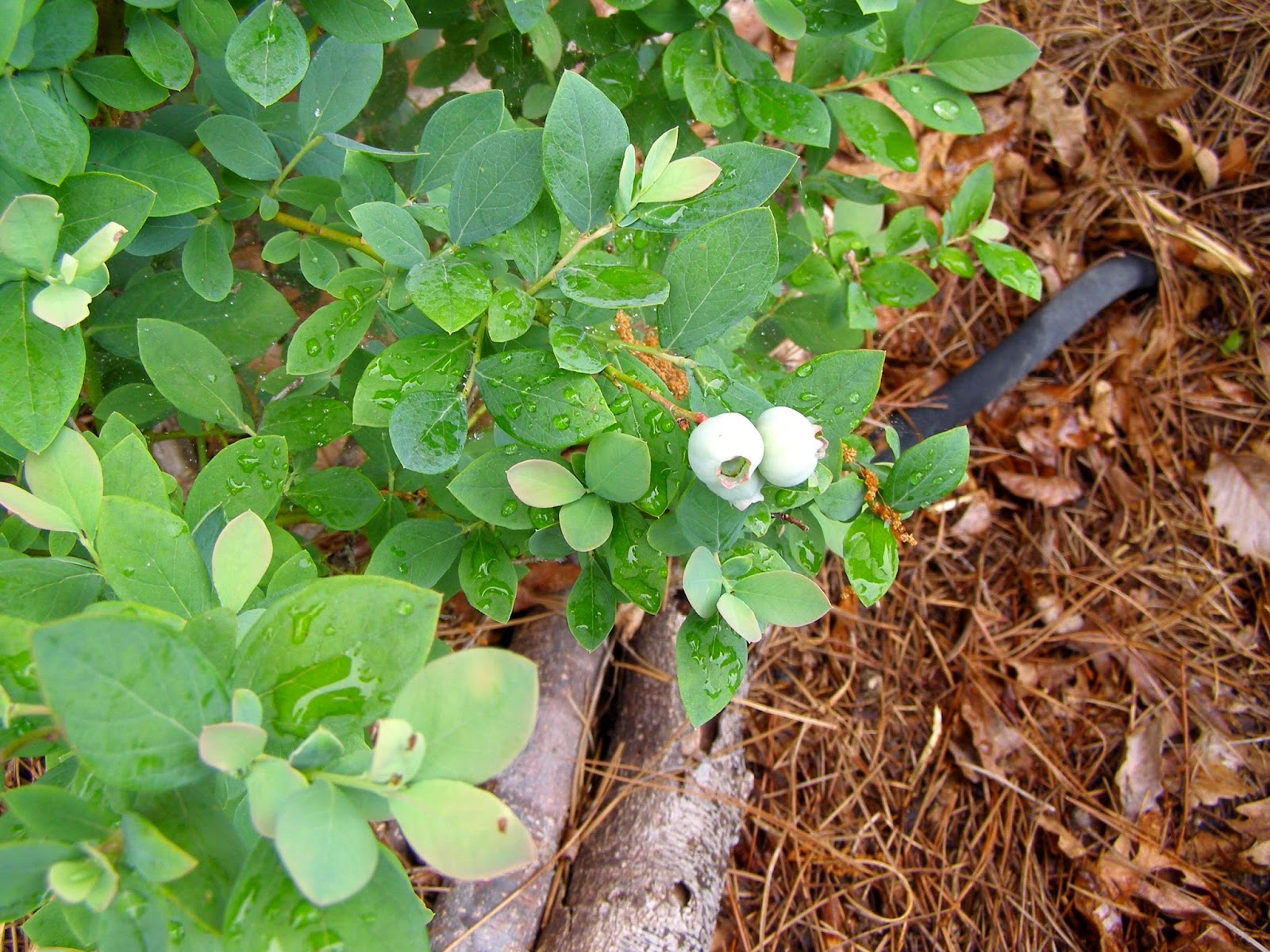
Blueberry
Blueberry
Blueberries are not yet blue, but I am looking forward to eating them. Even when they turn blue, we don't "pick" them -- if you touch them and they don't drop in your hand, they're not quite at their perfect sweetness.

Hyssop
Hyssop
In the Bible, it says "purify me with hyssop, and I shall be clean" but I use my hyssop to attract pollinators, and for cut flowers. It's an excellent companion plant in the garden, and has an attractive "small shrub" shape. I do plan to try some in tea, as WebMD notes it can be helpful for everything from menstrual cramps to cough/cold.

Fig
Fig
The fig lives!! Thank goodness! This fig was propagated by my father, from the large fig tree that grew outside my bedroom window when I was a child. I was working to espalier it against the brick, but the long, cold winter caused it to die back to the ground. The current plan is to "roll with it" and use the dead branch as a trellis of sorts to train the new, flexible branches.

I know that some years it might start where it left off, and some years it might begin anew, and I am okay with that. Plus, then I can string Christmas lights on the branches either way!


Friday, August 30, 2013

Dog Days: Garden Tour August 2013


Espalier
In the transition to edible landscaping, I have to practice patience, as I wait for the blueberries to reach their mature height of 5-6' (still another year or two off). My fig is a cutting from the fig that grew outside my bedroom window when I was a girl. (That espaliered tomato on the left is Matt's Wild Cherry, by the way, which only needed the merest help from a small trellis to grow right up the wall!)


Breakfast
The figs are ripening now, and are an amazing treat halfway through a gardening "workout". This fig is the direct descendant of the very first fig I ever tasted. 

Brandywine
My tomato harvest this year is paltry, compared to years past. I planted them late and staked them late. I put them in my sheet-mulched bed, which I am still finishing, so things there had to fend on their own, in large part. I was a little surprised to see how well my Brandywine (started from seed, no less!) fared, so you can bet I'll plant that one every year. This plant is beautiful, and I expect it to keep producing till frost. 

Chard
This is the first year I planted chard, which has stayed lush and delicious all spring and summer! Excellent sauteed, or made into a "sauce" with ricotta cheese (thank you, Moosewood Cooks at Home, for a recipe so delicious my 5-year-old requested leftovers for breakfast). 

Pollination
My favorite new "edible landscaping" structure is my stone circle in the middle of the yard. This year, I planted it with Scarlet Runner Beans to form a teepee (that yes, the kids can play in). I planning to rotate crops here. After the first frost, I'll put in a cover crop, along with diggables (garlic, shallot, maybe some carrots), do a design with different color lettuces in the spring, then tomatoes for summer.

Spicy
Porch
I've had good luck with pepper plants this year, including one in a pot on the front porch. Jalapenos, a "salsa" pepper from a local nursery, and sweet red peppers are all *almost* ready to harvest. The spicy salsa peppers are ready when they turn red (maybe two more weeks, now that they've gone from green to yellow).

Fallow
This time last year, my front beds were bursting with tomatoes and flowers. This year, as I've cut back herbs and removed spent flowers and cabbages, I've left spots bare/mulched, so as to plant fall vegetables. Above, you can see the bottom of the cherry tomato from the first picture. All those small bunches of green plants scattered across the bareness are oregano and parsley that have self-seeded (or been moved by me in clumps). By October, they'll have filled in the areas around the fall vegetables, acting as ground cover. 

Autumn
First starts for fall: cauliflower, broccoli, chard (many colors), fennel, mustard green, kale.

As an aside, I learned this year that "Dog Days" aren't really in August at all, but are in July. They


Monday, May 27, 2013

Lunch from the Garden

Sink full of freshness: spinach, lettuce, chard, peas, strawberries.
The best part of "edible landscaping" is doing the munching. There is nothing like picking your lunch! Truly, I have a garden to entice my kids to try new things....and it works, if you're patient. Besides, if something doesn't taste good, spit it on the ground! Mulch!

"Leaves and carrots," she calls it, with homemade ranch dressing.

Mine is sauteed with garlic, butter, and olive oil. Tastes like spring!

Saturday, December 8, 2012

Beauty in the early winter garden

This kale is gorgeous in the flower beds, and just as pretty as kale chips!

More kale. I love the purple and wish I'd planted about twice as many of these. I'll  be interested to see how they fare with a hard freeze.

Tarragon blooms in fall! Who knew? Leaves are tinged with purple where the frost has kissed them. Bumper crop for this year's holiday Bernaise.

We haven't gotten below 20 degrees yet at my house, so even the Gerber daisies are still blooming a bit, though their red is not as bright as in summer.

Also hanging on are lovely clumps of Sweet Alyssum, which will decorate rocks/overhangs until we get a truly hard frost. 


Broccoli in pot on porch.


 After the crape myrtles flower, they produce their own seeds. This dry, tulip-shaped pod is what remains for the winter dormant season. I have learned to find the beauty in the fallow season, the fallow spot. There is always the promise of new life.


Monday, September 17, 2012

Seeds are the Strongest Magic

“Oh, heart, if one should say to you that the soul perishes like the body, answer that the flower withers, but the seed remains.”  Kahlil Gibran
I teach my children that there is magic in a seed. Inside a tiny seed is a whole plant, which will grow and be pretty and give us lots of food...and it will make hundreds of more seeds that we can plant again if we wish. A seed is Holy.

Back during the August Garden Tour, I shared a picture of my lettuces going to seed. About a month later, when I found the dry seed pods, I finally broke one open and was amazed at the bounty. I started sprinkling them back into my garden since this is the perfect time to plant a fall crop, and then realized that I need to save some for spring so I won't have to buy new ones! This is my first year really attempting to save seeds of all my favorite things, like the Matt's Wild Cherry and Super Sioux tomatoes, the Rosa Bianca eggplant, and my wonderful lettuces, of which I hope to enjoy fall/winter crops here.

Above, you can see the flowers. When they fade, and all looks dry and dead, don't be fooled. There are miracles inside the pods where the flowers bloomed! Below is a picture of one cluster of "flowers" I picked and brought inside, so you can get an idea of size/appearance.

Inside each dry pod are about 10-15 seeds. I'm pretty sure they're probably Bunte Forellenschluss, which is my favorite of all the lettuces I've planted. The Buntes have beautiful bright green leaves dotted with a reddish-purple, and a lovely mild (almost sweetish) flavor and a gently crisp texture.  I did plant other varieties nearby, so this year I will be getting the luck of the draw! I'll have to update again when they sprout leaves in the coming months. Magic. Miracle. Life.

For those of you who want to save tomato seeds for the first time, I have learned that you cannot "just" save the seeds; they need to ferment a bit before you dry them. It's not difficult and Mr. Brown Thumb has a terrific picture tutorial so I don't have to do one!

I also need to note that only with heirloom plants can you be certain the fruit that springs forth will be the same as the plant from which it was harvested. This doesn't mean you can't save seeds from hybrids, of course, just that you should expect to be surprised at what grows! I mostly grow heirlooms because my goal all along has been to save seeds, but each year I do get a few volunteer (natural) hybrids, including one year something that seemed to be a Purple Cherokee plum tomato that was terrific. 

"Keep on sowing your seed, for you never know which will grow — perhaps it all will." Albert Einstein

Monday, September 3, 2012

Best Bloody Mary Grows in the Garden

As today is the Labor Day holiday here in the U.S., I thought it fitting to begin the day with Labor (today: laundry and organizing) and then go for a pre-lunch Bloody Mary. Imagine my dismay when I realized that we had no Bloody Mary mix in the pantry. I did spy some V8 juice, but I'd much rather drink that plain than mix it with anything.
Garden Bloody Mary Mix
Looks delicious, doesn't it?
In general, I try to find the advantages of every situation so I told myself, "well, a V8 isn't really festive, but I guess all in all it's a healthy option," when I remembered that I have a freaking Kitchen Garden! I have an abundance of fresh tomatoes and herbs and such. Surely there is no need for me to go without my beverage of choice on this holiday. It's not exactly urban homesteading, but it's a nice degree of self-sufficiency.

I am glad I embarked upon this endeavor! And I strongly encourage you to try this. 

If you can make a smoothie, you can make your own Awesome Fresh Bloody Mary!


Make a Bloody Mary with fresh ingredients from your garden!
Here are my ingredients: fresh tomatoes (Super Sioux and Martino's Roma), fresh parsely, fresh basil, one fresh serrano pepper (most of seeds/pith removed) leftover chopped tomatoes/onions (in bowls) from last night's dinner, cucumber, juice from one lime, horseradish, worcestershire, salt, pepper. Lemon is for garnish. 

Chop tomatoes, cucumber and put in blender with other ingredients. Puree, taste, and adjust seasonings.

Now, some people may prefer to peel the tomatoes beforehand, but that is way too much trouble (and heat, and energy) for me. After pureeing, I just strained out the seeds/skin with a sieve, as described here. Seriously easy. The whole process, start to finish (including taking these pictures and two interruptions from children) was less than a half-hour.

Garden Bloody Mary is better than Zing Zang
Wow...could it be better than Zing Zang?
Becky's Bloody Mary Mix...I like the sound of it! The tiny chef inside said to put it in the fridge for an hour to let the flavors marry, but the tiny scientist inside wanted to try right away and an hour later to see if there was a difference. The tiny bacchanalian agreed with the scientist, so I went ahead and made an experiment.

The result is a Bloody Mary with a nice initial "kick" from the pepper and a nice depth of spice from the horseradish. I was pleasantly surprised by the sweetness from the fresh tomatoes. I loved the citrus and cucumber mixed in there -- very refreshing! As I suspected, the flavor was overall better on the second one. I also went low on the salt, with the plan of doing a salt-rimmed glass, but (as you can see) I forgot, so I ground a little sea salt right on top and let it "melt" into the beverage as I sipped. That was quite nice also.

Who needs a mix???  


Tag Cloud

Make Your Own simplify Easy garden Inside My Fridge Living on Less recipes food frugal Live Well meal plan Tennessee Edible Landscaping Kitchen Garden organic Garden Tour Spring flowers Real American Food Use It All change vegetables Dinner Grow Your Own grow tomatoes Life Love Summer greens kids Family dinner recipes explore gift seeds Companion Plants Lettuce Reality Sink Saving Seeds bread freezer garlic squash Fall Inspiration Special Try It and See emotion moderation planting quick reduce Art Artisan Bread Beauty CSA Celebrations Cool Beverages Cucumber Experiment Featured Flood Sheet Mulch Small Changes Tea craft fruit reuse soup stock waste yogurt "sometimes food" Amaryllis Becky's Favorite Things Bloody Mary Blueberries Books Cabbage Chard Connections Date Night Edible Flowers Family Dinner Jacob's Ladder Lint No-till Organize Read Real Life TN Native Plant Trash Day Use the Oven Winter black-eyed susan chicken crock pot daily reminder essential oil garden pests kale leftovers permaculture plastic pork potatoes recycle rudbeckia seedling stir-fry strawberries swale trash vegetarian volunteer A-frame Authentic Authentic2 Bacon Baking Fail Better Homemade Body Balm Breakfast Build Soil Butter Carrots Chives Chocolate Milk Chocolate Syrup Christmas Clean Cookbook Review Crock Pot Bread Eat Local Faith Fire Cider Food as Medicine GM foods GMO Ginger HFCS Health Holy Honeysuckle Hot Cocoa Household cleaner Hydrangea Icebox Pickles Iced Mocha Immune Booster Iris Kitchen Sink Lent Life Notes Monsanto Morning Sink My Neighbor's Garden Pickles Placating with Plating PlantEaters Propagating Geraniums Sacred Salvia Leucantha School Lunch Sewing Slow Cooker Bread Slow Cooker Fail Spiderwort Spinach Spiritual Practice Spring roll Sprouts Thanksgiving Time-saving Tips Tincture Turkey Turmeric Victory Garden Vodka Water Kefir What Chefs Feed Their Kids basil bento berm birthday borage brassica broccoli cabbage worm cake canned tomatoes chili coconut compost dessert discipline eggplant eggplant parmesan fennel flour food waste frosting gluten green beans greenhouse grocery healthy hair healthy scalp hornworm hugelkultur icing knead kneading kohlrabi landfill lasagna garden nasturtium natural hair wash no poo pancakes parsley patience pests pizza plantain potager processed sangria seed pot smoothie standing desk substitute for dill tarragon teacher appreciation teacher gift vegan water window crayons yeast

Eat Locally!