Showing posts with label Dinner. Show all posts

Sunday, July 13, 2014

Season's First Eggplant = Eggplant Parmesan with Roasted Tomato Sauce


Eggplant Parmesan
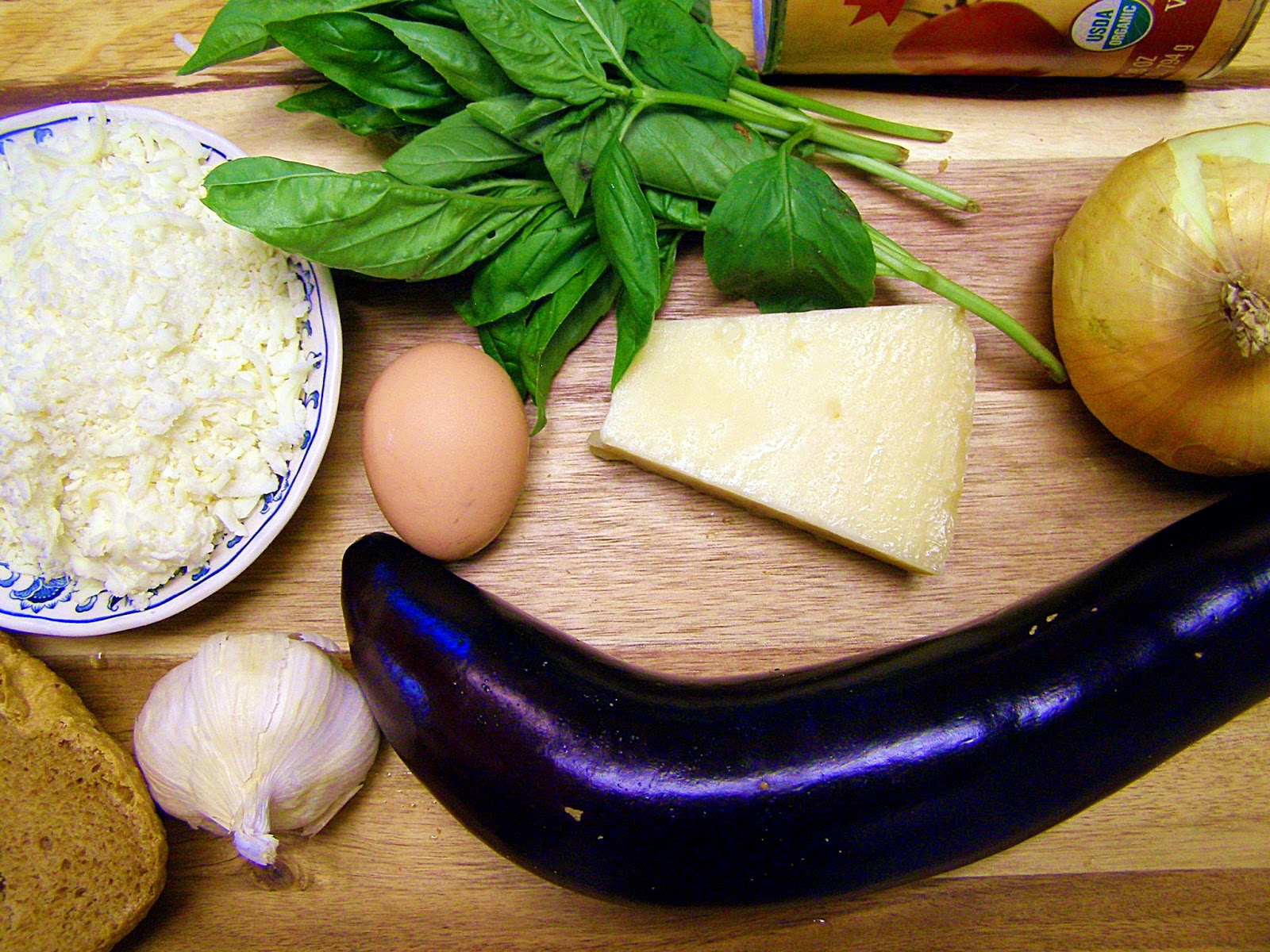
We returned from vacation to find our first beautiful eggplant. Usually, I like to make Eggplant Parmesan with a fresh tomato sauce, but all the growing tomatoes are green and I've used up last summer's frozen tomatoes. But my pantry always has a jar or can of organic whole tomatoes, and I have plenty of fresh basil, so dinner is on. 

Roasting canned tomatoes is a great way to bring out their flavor, so that's my plan for the sauce. You can use a jarred sauce for this if you want (and I use plenty of that for pizza and such), but your eggplant will thank you if the sauce is fresh....and it's really easy.


First, preheat your oven to 350F. Then, find a pan in which the tomatoes will fit snugly, but not be on top of each other. A 9" square/round pan is usually great, and most people have these in the kitchen. Add a touch of olive oil, chop an onion, add a dash of red pepper flakes, and pop it in the oven for 10 minutes or so. You want the onion to soften, but not brown.

Canned tomatoes
While the onion is roasting, drain (and save!) the juice from your can of tomatoes. We'll add this back in later, but we want the tomatoes to roast, not stew. I actually had a half tomato from the garden so I chopped that into large chunks. Grab a few cloves of garlic and peel them. If they're large, split them down the middle. You can also see some shallot I found that needed to be used.


Roast tomatoes
When the onions start to soften (as you can see, mine were not quite translucent yet), add in the drained tomatoes, garlic, shallot. I added a splash of olive oil, salt, and pepper and stirred it up. Now it goes into the oven for 30-40 minutes to slow-roast.

Fresh Eggplant
While that's roasting, it's time to work on the eggplant, which needs to be sliced thinly (maybe 1/4" slices). You can see two tins: one has some seasoned breadcrumbs, and the other has a beaten egg with a little water added to stretch it. Dip the eggplant slices in egg wash, then in the bread crumbs, and put them on a cookie sheet. Roast them at 350F for 5 minutes, then flip and roast for another 5 minutes.

I found this no-fry technique for eggplant here a few years ago, and I strongly prefer it to frying the eggplant in a skillet. It stays crisper, is healthier, and I don't have to have both the stove and oven going in a Tennessee July. I don't make eggplant parm in the winter....eggplant is a SUMMER vegetable and the flavor is far superior when it's fresh. 

Also, when I pick eggplant fresh, I almost never find that it's bitter, or that the skin is tough, and I never have to salt it ahead of time. Word to the wise: TASTE a piece of the raw eggplant to be sure! In fact, taste everything as you go. You'll learn a lot about how flavors develop.

Roasted tomatoes
Above, you can see the tomatoes after about 35 minutes in the oven. They smell divine.
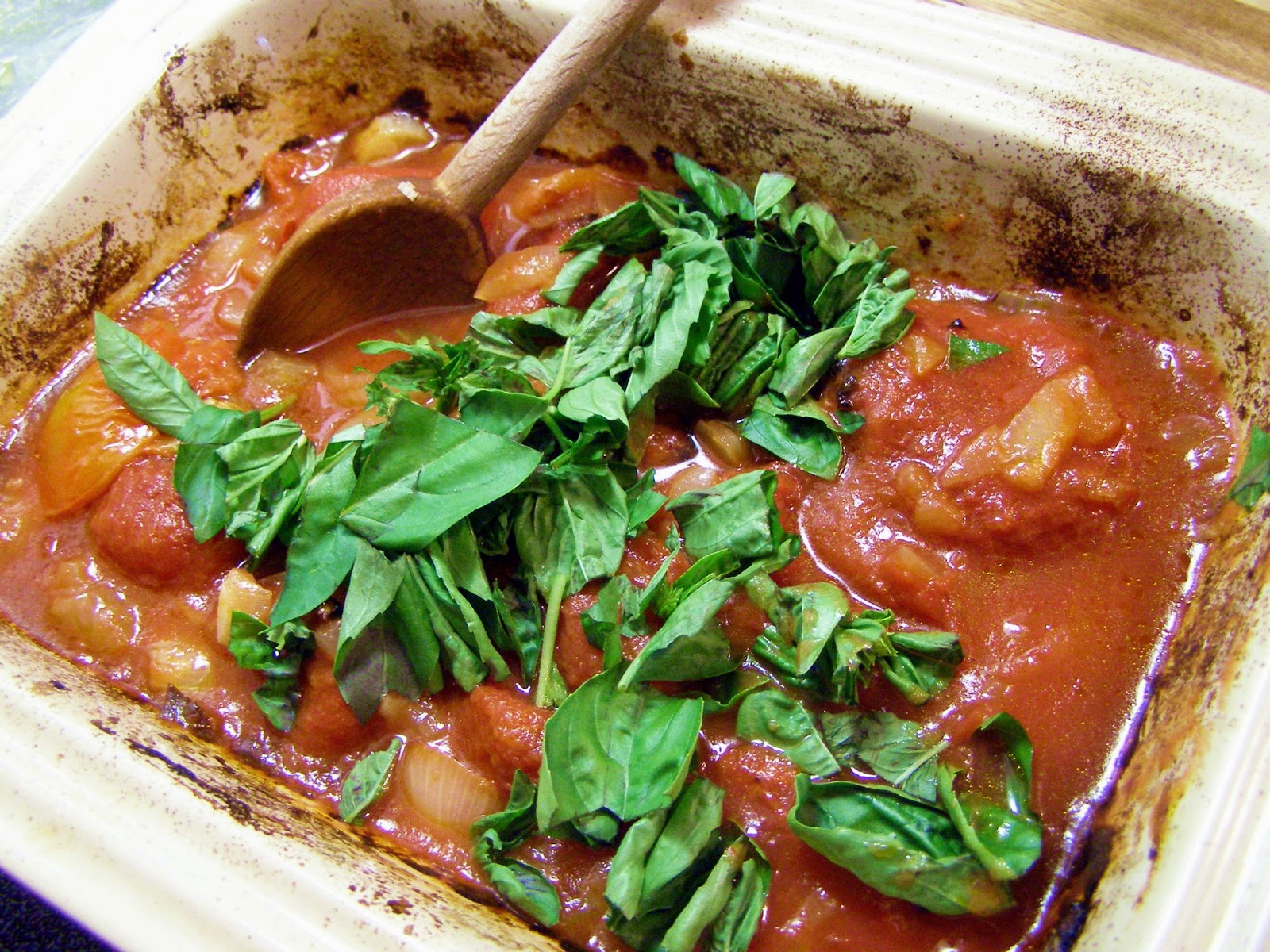

Next, roughly tear the basil leaves, and mix them + the reserved tomato juice all in with the roasted tomatoes. This is then set aside to cool a little while we finish roasting the eggplant slices. (Taste it.)

Quick tomato sauce
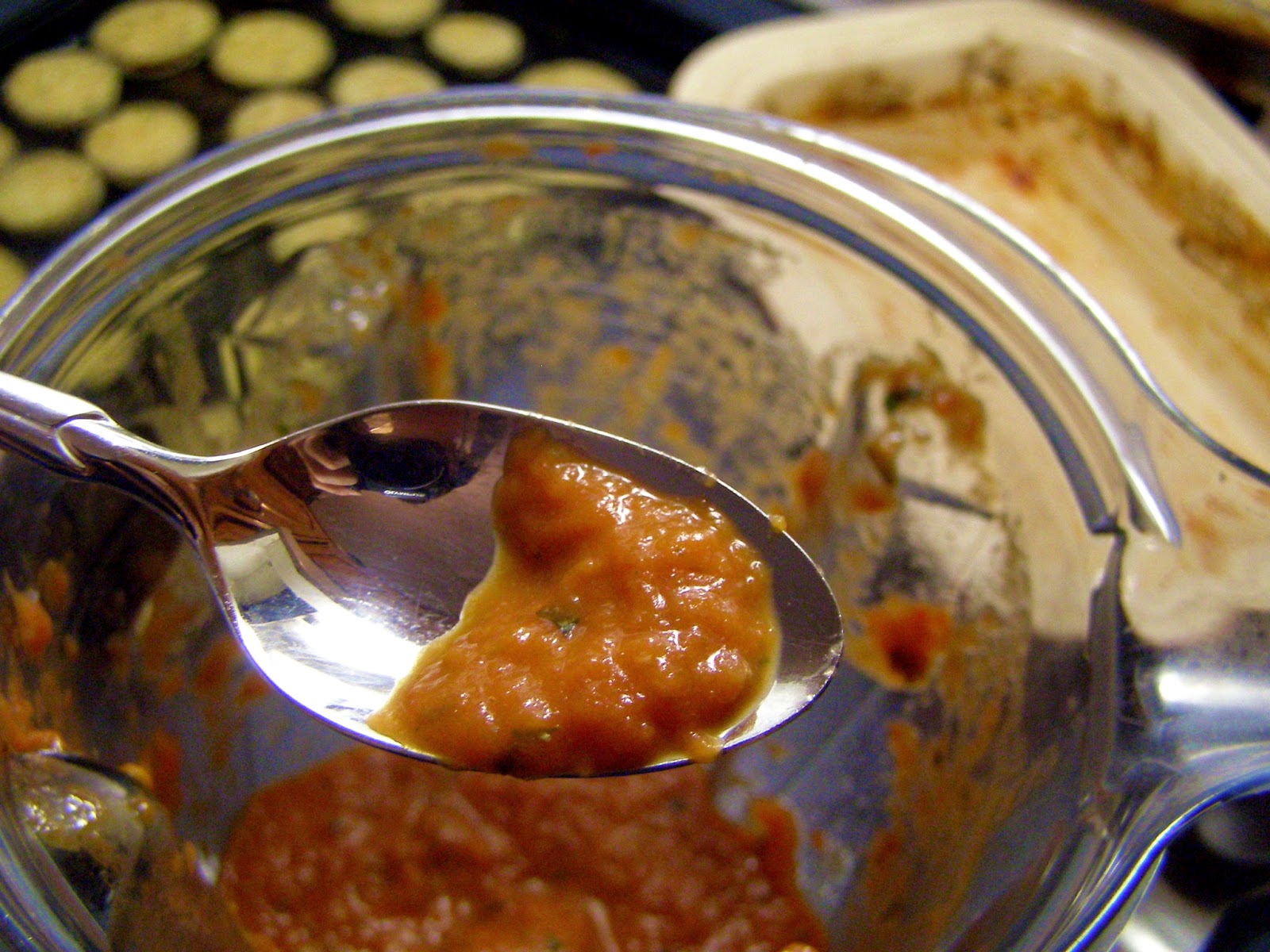
Once the sauce cools a little, dump it all into the blender and let 'er rip. Then, (of course) taste the sauce and see if it needs salt or pepper. This is also basically how I make my fresh tomato sauce (minus the roasting of the tomato). With roasted or fresh tomatoes, it is unlikely you will need any sugar. Sauce made this way will look a little pinker than jarred sauce, and it should taste really fresh.

Now, at this point, you can (1) set everything aside and assemble the dish shortly before you eat, (2) assemble the dish and store it in the fridge to bake later, or (3) assemble and bake now. If you put it in the fridge, I recommend putting it in a cold oven so it can warm as the oven preheats.


Eggplant parmesan
Assembly: put some tomato sauce in the bottom of your dish. Layer in the eggplant slices. Top with grated mozzarella and grated parmesan. Then start over, until your dish is full.

Eggplant parmesan
Here's the dish, ready for the oven. Bake at 350F for 30-45 minutes until browned and bubbly. (So, check it at 30 and see how it looks, but know that it won't need more than 45 to cook thoroughly.)
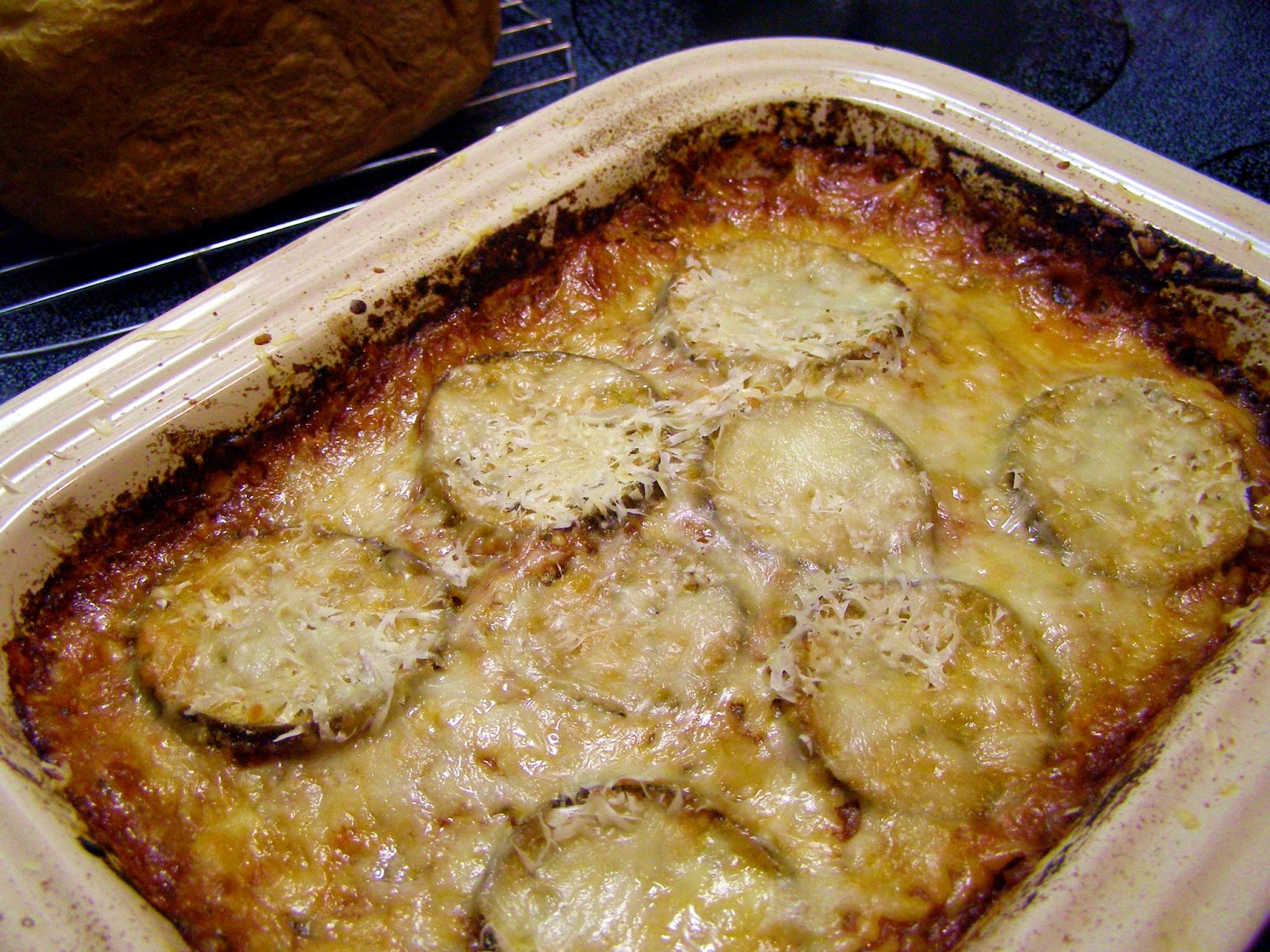
Eggplant parmesant
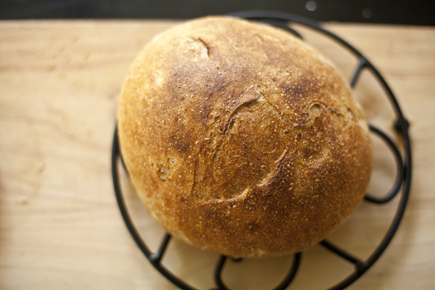
Here's the finished dish, ready for dinner! I've set up a "glory shot" here, with the homemade bread in the background. Three out of four family members rated this dish a "10," and we picked up some more eggplant at the local Farmer's Market to enjoy the bounty of the season!

Buy seasonally. Cook simply. Eat well!


Wednesday, December 11, 2013

Just eat together.

When I started this blog, my goal was to post at least once a month, and I've met that goal until recently. My spouse is in the armed forces and, of late, frequently away from home for long stretches, leaving adult energy stretched thin down here South of Sunnybrook.

I've always been a big fan of family dinners. I loved them when I was a kid, and I love them now. I find it harder to have regular family meals when the other adult is gone, but the ritual of dinner, the giving of thanks and sharing with each other, this is what keeps us sane.

I think the idea of family dinner can be intimidating sometimes. But a bucket of fried chicken around the table is "family dinner." Baked potatoes and broccoli is family dinner. I prefer homemade, but it certainly doesn't have to be fancy.

"It is what it is"
And on the night I took the picture above, I'd been working for a day or two at one end of the table, with beans drying at the other end, and the kids had colored there in the afternoon.  As you can see, we just scooped out spaces for our plates and lit the candles (which "makes it special" according to my kids). By the time the fish was ready, I just didn't have the energy to lead a full-on table clearing, so I let it go.

Sometimes the perfect is the enemy of the good. On this night, we laughed, and shared, and had a great time surrounded by the detritus of our busy, bountiful lives.

Share time. Offer gratitude. Eat together.

**********************************************************
And just after I posted this, a friend shared this link on Facebook. Quote: "...life on this little blue planet is too precious and fragile to be spent lamenting crusted Raisin Bran in the sink. That what really matters is grace, forgiveness, and understanding. And love. Always, unequivocally and without fail, love."

Sunday, June 23, 2013

Crock bread falls flat, twice

This Spring, I saw a really intriguing link on my Facebook feed that said "You can cook Bread in your Crock Pot! - It takes less time than the oven because the rising time is included in the Baking."  Despite the weird capitalization, I was intrigued!

Not my slow-cooker bread
I did a quick web search for "slow cooker bread" since that Facebook page did not include the URL from which the pictures originated (a huge peeve of mine). Thankfully, the blog was easy to find, and you can read the original post here. She uses an artisan bread, which I cook regularly, so I was ready to go.

According to the directions, you place ~1 lb. of dough in your crock pot on parchment and turn it on high. In one hour, you have delicious bread! 

That sounds so simple.....

Here is my dough, ready to go, in my 8-quart slow cooker. I added the lid and turned it to high.
One hour later: the dough flattened (instead of rising) and was gummy and raw. The lid was beginning to take on a lot of moisture, so I cracked it a bit, so as not to soak the loaf. I held out hope.

Two hours later: still not done. I finally pulled it out around the 3-hour mark, and the results were...flat. Here you can see the crock loaf (l) next to one baked in the oven (r).
Despite these bad results, I remained undeterred. Perhaps the 8-quart slow cooker was too big or too hot. I read the comments on the original blog post and decided to try my 1-quart crock instead. A crock uses a lot less energy than an oven, plus no hot kitchen in summer, right? I had to give it another go.

Dough ready to go in my 1-quart crock. Fingers crossed.

Once again, it took several hours to achieve anything approximating "done."
While it did not flatten, due to lack of room in the crock, there was no rising.
Here, the "finished loaf" at 2-ish hours is not terribly appetizing.
Crockpot bread
Second crock loaf (l) is the same height as oven-baked (r), but horridly doughy and dense
due to lack of rise.  The oven loaf spreads a bit, then rises, and has a wonderful texture. I even put the top of the crock-"baked" loaf under the broiler, so it had an even color, but it tasted awful anyway.

 After having zero rise on the second loaf, I decided this method is not for me, unless I get helpful feedback in the comments. The artisan bread takes at most one hour, and I'd rather fire up the oven for a consistent, successful result loved by the whole family than keep trying at the crock.

If you get different results, let me know. If you're only moderately interested in slow-cooker bread, because you want to try something new, I recommend trying instead the Soft 100% Whole Wheat Dinner Rolls from An Oregon Cottage. They are soft and tasty...and I made them without a stand mixer, several times, with consistent, delicious results!

Saturday, April 7, 2012

Better than a Bakery! Artisan bread for dinner in less than an hour.

There is nothing like still-warm-from-the-oven bread on the dinner table.
I absolutely love freshly-baked breads and muffins, but have always found kneading/rising and the intricacies of yeast to be daunting. It all just seemed like a lot of work when I can pick up a really nice loaf of bread at the bakery for a special dinner. Then I started hearing/reading about "no-knead artisan bread" and was intrigued. Finally, about two years ago, I stumbled across this "Artisan Bread in 5 Minutes a Day, Seriously" post and decided to give it a try. 

Basically, it goes like this: dump ingredients into bowl, mix, cover loosely/let rise, put in fridge. Later, cut off dough, let sit, put in oven, eat yummy bread. Have I mentioned how my family raves about this bread? So, here it is again, with pictures. A printable recipe is here.

My ingredients: Flour (my "everyday" flour is a mix of unbleached white and King Arthur's white wheat), flaxseed meal, yeast, kosher salt, and warm water.


Put 1 1/2 Tablespoons of kosher salt and 1 1/2 Tablespoons of active dry yeast in a large bowl. If you are using the packets of yeast (this is what I bought at first), use two. Now that I make bread often, I buy yeast in bulk. I keep a jar of yeast in the fridge for regular use and store the rest in the freezer.

Add 3 cups of warm water (from the tap is fine). It should feel warm to the touch, but not hot.

Add 6 1/2 cups of unbleached all-purpose flour, using the "scoop and sweep" method to measure. This is a great place to experiment! Whole wheat, spelt flour, sprouted grains flour, etc. Here, I used 6 cups of my unbleached white/white wheat mix and 1/2 cup of flax meal. I love the subtle, nutty flavor of flax meal, it gives a beautiful color/texture to the bread, and it's also a really great thing to put into our bodies

Mix until there are no more dry spots of flour. You can use a mixer if you have one, but I don't and I wouldn't use it for this even if I did. Here I am about halfway mixed; it's coming together, but I still have spots of dry flour.

Here, it's well-combined and ready to rise! I scrapes down the bowl sides also. I have a lid for my bowl  with holes punched in the lid (more about that later), but you can just loosely cover your bowl with plastic wrap.

Bread rising: pictures from l-r at 2:30, 3:30 and 4:30, respectively. You can cut off a bit now for your first loaf or just pop it right into the fridge, which is what I did this time. I think the flavor develops better if it has some time to sit. With this amount of dough, I'll typically make three loaves over the course of 5-8 days. You can leave the dough in your fridge up to two weeks; it will develop more of a "sourdough" flavor as it sits.

You need to bake in a preheated, 450-degree oven. You can bake it in whatever you usually use in the oven: pyrex pan, pizza stone, cookie sheet, cast-iron skillet. I did try baking on a pizza stone with a little dish of water, but decided it was too fussy for me. Then I went searching for other options and loved the idea of using an enameled dutch oven as shown here at Oregon Cottage. I don't find that I need the parchment paper she uses and my dutch oven is quite large, but I use a little enameled stoneware baking with a lid. The crust comes out beautifully with this method! 

Whatever you use, I recommend preheating the dish in the oven.

Here is the dough the following afternoon when I took it out of the fridge. As you can see, it lost a bit of mass as it cooled. Sprinkle some flour on the top and dust your hands. Have a sharp knife or kitchen scissors ready.

Pull and cut the amount of dough you want. Then stretch the dough to create a gluten cloak. 


I did not even attempt to photograph myself shaping the loaf because this short video will be much more helpful.


Do note that your bread may look different from the bread in the video because she used 100% white flour and bread flour at that! Here is what my finished loaf looks like before I let it rest. You should really let it rest for at least 30 minutes, though 45 is better if you have the time. I have popped it in the oven after only 15-20 minutes in a pinch and it comes out fine, though it doesn't rise up quite as much in the oven.

Before baking, dust the top of your loaf with flour and then slash the top (I sometimes do an X design as well). I pop mine in the hot pan, put on the lid and cook for 15 minutes. Then I remove the lid and cook an additional 15 minutes. When it's finished, the crust should be brown and it should sound hollow when tapped. Remove to a cooling rack.

To store uneaten bread, turn the cut side down on a plate or cutting board. Sometimes I wrap it in a clean tea towel. I did try storing it in a plastic bag but the crust became soft right away and I found it was prone to mildew in the summer as we are in the humid South.

If you start making this often, as I did, you'll probably want to invest in a bowl with lid that is a good size for your fridge. I'd initially meant for this picture to show the holes drilled in the lid, but then I saw the cool reflection of my kitchen window in the lid and went that way instead. Just make sure the dough is mostly covered but has a way for any gases to escape.

I cannot believe how easy it is to make fresh bread for dinner! Basically, I make a ball, let it rest for 15 minutes, preheat the oven and my pan, pop it in when the oven beeps that it's preheated and cook for a half hour. It's simple to do while making other food -- or to have fresh bread for a leftover night. I love being able to take freshly baked bread when I visit a friend or neighbor.

Updated 4/8 to add picture of bread interior. This was the last loaf from this baking and had been in the fridge for about 6-7 days. The crumb is denser if I use a higher proportion of wheat flour, I have found. The little nooks/crannies make excellent buttered toast!

I hope you will try your own hand at making this simple and delicious bread! I encourage you to explore further, either via web search or here at the original Artisan Bread in Five web site. 

Bon appetite!

Thursday, December 1, 2011

Date Night Leftovers = Crab Cake Eggs Benedict

Under Construction: Toasted artisan bread, crab cake, scallions, poached egg, remoulade (don't forget the Bloody Marys)
We are lucky to have my parents living quite close and, occasionally, they invite our children to spend the night. Sometimes we use this occasion for a dinner out or, more often, as a chance to go see some of the amazing live music available to us here in Music City U.S.A. But really our favorite thing to do is cook together the way we used to do before we had kids.

Back in The Day, we'd leisurely peruse the aisles of the supermarket, possibly having a plan for our meal or possibly waiting to be inspired. So on this recent date night, plans to play golf got rained out and we decided to do five-course dinner instead, followed by "playing" (i.e., me learning) chess by a roaring fire. Delightful!!

I don't have pictures for everything, but the food was so beautiful I couldn't help but snap a few pictures here and there. We hadn't done this in so long that I have to admit we got a bit carried away, but it was an awful lot of fun and a splurge I do not regret!

First Course
Fried Green Tomatoes (Brandywine) with  Goat Cheese and Stone Ground Mustard

Second Course
Mahi, oil-poached with pineapple sage, Garlicky Fingerling Potatoes, Broccolini

This beauty was 100% the spouse's brainchild: oil poaching without requiring a full pan of oil, with the bonus that we could finally use the fancy food saver. He prepped the mahi and cooked it in some low-simmering water, but 3/4 of the way through the damn bag broke, so it was only mostly "oil-poached." Making the most of things, we tossed our broccolini in the herby/lemony water with the fish and it turned out to be a happy -- and quite tasty -- accident in the end. 

Third Course
Crab Cake with Remoulade

Fourth Course
Lamb Chops with Roasted Fingerling Potatoes

Fifth Course was a cheese plate, for which I have no photo. I also must stress that, if you want to do this, the key is small portions of everything (that one piece of mahi, for example, yielded our two "portions" plus leftovers). You want a lovely taste, an exquisite mouthful or two to savor, but then you need to cook the next course, so if you get overloaded you might decide (like I did) to forego that lovely pea puree that would have been beautiful with the lamb and potatoes. C'est la vie. We had leftover broccolini and that was good enough for me!

The following morning, we woke and went about our day at a leisurely pace, enjoying coffee and then Bloody Marys, which lead to the inspired idea (again, credit to my spouse) to make a fantastic Eggs Benedict with our leftover crab cakes and remoulade. Then he strummed the guitar and indulged in a nap while I painted. 

Feed the body. Feed the Soul. Appreciate Our Time. Live Well.

We are planning a frugal-minded version of the 3+ Course Date Night very soon. Not surprisingly, it's easier to take pictures when the photographer is not also responsible for all of the cooking and prep, so I feel confident I'll be able to share that with you as well.

Wednesday, June 22, 2011

Placating with Plating: Pork, Rice, Squash

You eat with your eyes first. But adult eyes and child eyes often see things a little differently. Who cares? Does it really make that much difference if the priority is an appealing balance of colors or enough "white space" on the plate or just making sure the food is not touching more than necessary?

Tonight's dinner: Jasmine rice with peas/carrots, free-range pork chops and a medley of roasted yellow squash, pattypan squash, garlic chunks and kohlrabi. A little freshly-baked wheat bread rounds out the meal. For some reason, many children, including mine, seem to prefer their food as segregated as possible. Should we call it "deconstructed" instead? It's not terribly hard to manage generally, so I try to honor that preference without being ruled by it, as evidenced by my rather brazen addition of peas/carrots to the rice.

The biggest differences between kid/adult plates are onions and veggie portioning. I topped my rice with sauteed onions and orange-pineapple jus from the pork pan. The kids got one piece each of yellow squash, pattypan squash and kohlrabi, while my plate is piled high with all those plus some garlic chunks. The bright green, orange and yellow of the veggies are offset brilliantly by the white rice and white plates, so this was a colorful and appealing early summer meal.

Not counting the bread, this could easily be a 40-minute dinner. The bread baking takes about an hour (counting time necessary to preheat the oven), so technically it's an hour prep. Swapping fresh bread for heat-and-serve rolls or skipping bread altogether makes pork chops one of my favorite "go to" meals after a hectic day on the go. I'll include a rundown after the break.

Dinner doesn't need to be fancy. Heck, it doesn't even need to be homemade. Really, it doesn't even have to be dinner -- it could be breakfast. It just needs to be time together to share and nourish body and soul.

For the record, the children ate rice, peas, carrots, bread/butter and pork. It was not surprising that they didn't touch the squash, but they did ask what each one was called and (amazingly) no one disparaged this vegetable that still holds a strong "yuck factor" for them both.


Monday, May 2, 2011

Full-on American Food

When I was a kid, I heard someone explain how a hot dog was the perfect illustration of a quintessentially American food. You've got a sausage from Vienna, bread from the Midwest and condiments from across the globe. I liked the idea of food illustrating our melting pot, but really can't we offer up something better than a hot dog? If you say McDonalds I am now plugging my ears and running away screaming. I find it sad that most of the rest of the world thinks golden arches and Coca-Cola when they think of "American Food."

What is Real American Food? It's basically "peasant food." Real American Food is simple, fresh and easy to prepare. The thing that makes Real American Food unique is the surprising blend of flavors from around the globe.  I've worked in restaurants with some truly talented chefs. I've watched amazing chefs on television. They all say the same thing: get the freshest ingredients you can and cook it simply and you'll always have amazing food. I think it finally sank in when I started cooking with Alice Waters' The Art of Simple Food.


Tonight's dinner is Real American Food: Pork Chops with russet and sweet potatoes and Swiss chard. The pork, sweet potatoes and chard are all from a local farm with Avalon Acres. The russets came from Costco. Easy, breezy, simple meal.

Pork Chops with Potatoes and Greens
Season pork as early in the day as you can, but at least 30 minutes prior to cooking. I made up a rub with sea salt, pepper, chipotle powder, garlic powder, onion powder and a bit of brown sugar. You can season it the night before or in the morning and pull out of the fridge while you prep/cook other things. It needs some time to come to room temperature to cook evenly.

Slice potatoes and season lightly with salt and pepper. Brown in about 1/2 TBSP olive oil in skillet (they will not be fully cooked). Add chopped or sliced onions and garlic if you like. Remove from pan and add a bit of vegetable oil or bacon grease (just about a scant teaspoon or so). Brown pork chops on both sides. Add a cup or so of chicken or vegetable stock and scrape up the browned bits. Add back in the potatoes, cover and lower heat. Allow to simmer for about a half hour until the pork is cooked through and the potatoes are tender. Wash and roughly chop greens and add to pot; cook until tender (mine took about 5 more minutes).

I served this with homemade bread and some brown basmati rice since my children are hit-or-miss with eating potatoes. It's not fancy, but it sure is tasty.

Wednesday, August 4, 2010

Celebrate Summer Squash

,

Summer Squash and Sweet Corn Soup (with a kick)
adapted from Alice Waters

1/4 cup olive oil
1 large onion, thinly sliced
pinch saffron
1 tsp cumin
1 tsp coriander seeds (crushed if possible, just some dried coriander)
1/4 tsp turmeric
1 tsp paprika
1/4 tsp cayenne pepper (go to 1/2 or more if you like it hot)
2-4 garlic cloves, peeled and sliced thinly
5 medium green or yellow summer squash
3 cups chicken broth
3 cups water
1-2 ears fresh sweet corn

Heat oil in stock/soup pan.  Add onion, spices and garlic and cook over medium heat, stirring often.  Cook until very soft, but not brown.  While this cooks, slice squash into fairly thick slices (3/4").  When the onions are done, add squash and salt to taste.  Cook for a few minutes, then add stock and water.  Bring to a boil, then reduce to simmer and cook until squash is tender.  Cut the corn off the cob and add half at this point and cook for a few more minutes.  Let it cool a bit and then puree in batches in a blender until smooth.  Add second half of corn, then taste, adjust seasoning and serve hot with a swish of Yogurt and Mint (recipe below).

Yogurt and Mint
Pick a handful of mint.  Pick off the leaves and julienne.  In a small mortar, pound 2/3 of the mint to a paste, then stir in the remaining mint, about 1/3 cup yogurt, 1 TBSP olive oil and salt to taste.  If you like sweet with spicy, add a squish of agave nectar.  Enjoy!

Tag Cloud

Make Your Own simplify Easy garden Inside My Fridge Living on Less recipes food frugal Live Well meal plan Tennessee Edible Landscaping Kitchen Garden organic Garden Tour Spring flowers Real American Food Use It All change vegetables Dinner Grow Your Own grow tomatoes Life Love Summer greens kids Family dinner recipes explore gift seeds Companion Plants Lettuce Reality Sink Saving Seeds bread freezer garlic squash Fall Inspiration Special Try It and See emotion moderation planting quick reduce Art Artisan Bread Beauty CSA Celebrations Cool Beverages Cucumber Experiment Featured Flood Sheet Mulch Small Changes Tea craft fruit reuse soup stock waste yogurt "sometimes food" Amaryllis Becky's Favorite Things Bloody Mary Blueberries Books Cabbage Chard Connections Date Night Edible Flowers Family Dinner Jacob's Ladder Lint No-till Organize Read Real Life TN Native Plant Trash Day Use the Oven Winter black-eyed susan chicken crock pot daily reminder essential oil garden pests kale leftovers permaculture plastic pork potatoes recycle rudbeckia seedling stir-fry strawberries swale trash vegetarian volunteer A-frame Authentic Authentic2 Bacon Baking Fail Better Homemade Body Balm Breakfast Build Soil Butter Carrots Chives Chocolate Milk Chocolate Syrup Christmas Clean Cookbook Review Crock Pot Bread Eat Local Faith Fire Cider Food as Medicine GM foods GMO Ginger HFCS Health Holy Honeysuckle Hot Cocoa Household cleaner Hydrangea Icebox Pickles Iced Mocha Immune Booster Iris Kitchen Sink Lent Life Notes Monsanto Morning Sink My Neighbor's Garden Pickles Placating with Plating PlantEaters Propagating Geraniums Sacred Salvia Leucantha School Lunch Sewing Slow Cooker Bread Slow Cooker Fail Spiderwort Spinach Spiritual Practice Spring roll Sprouts Thanksgiving Time-saving Tips Tincture Turkey Turmeric Victory Garden Vodka Water Kefir What Chefs Feed Their Kids basil bento berm birthday borage brassica broccoli cabbage worm cake canned tomatoes chili coconut compost dessert discipline eggplant eggplant parmesan fennel flour food waste frosting gluten green beans greenhouse grocery healthy hair healthy scalp hornworm hugelkultur icing knead kneading kohlrabi landfill lasagna garden nasturtium natural hair wash no poo pancakes parsley patience pests pizza plantain potager processed sangria seed pot smoothie standing desk substitute for dill tarragon teacher appreciation teacher gift vegan water window crayons yeast

Eat Locally!