Showing posts with label Experiment. Show all posts

Tuesday, July 15, 2014

Soothing Body Balm, with Lemon & Lavender

 Natural, soothing body balm
I have fairly dry skin, especially in the winter. I used to slather my face with Vaseline before bed, but wanted to find a non-petroleum alternative (FYI, aquaphor is 41% petrolatum). I began experimenting, trying many formulas and ingredients, and this is my official "Becky's Body Balm" recipe. It is soothing, moisturizing, and chock-full of great stuff for your skin!

I started out making it as just a blend of oils, but it was too....oily. The beeswax helps a lot. If you make your own, experiment with varying proportions of ingredients to suit your taste and/or budget. 

The basic recipe is 1 part beeswax, 1 part coconut oil, 1 part shea butter, and 1 part a mix of olive/sweet almond/jojoba oils. I also add some raw cocoa butter, pure Vitamin E oil, and essential oils.

Step One: set up a double boiler. Mine is just a stainless steel bowl set over a saucepan filled with water. I turn it on to medium, but then keep it low once the water has heated up.

beeswax
Step Two: Add beeswax; I like these little pellets. Keep an eye on it and, when the beeswax melts, you'll probably want to lower your heat.

coconut oil
Step Three: Add coconut oil. I try to put in the things that can take a higher heat first, so the heat will only go down from here!

raw cocoa butter
Step Four: Add raw cocoa butter. This is what it looks like, if you've never seen it before, and yes, it does smell like chocolate. 

cocoa butter
I was so excited when I first got my cocoa butter that I decided to make something with only cocoa and shea butters, but what began as a "deliciously chocolate" aroma was so overwhelming after heating/cooling in my kitchen for a few hours that I actually became nauseated. Now I only add a small amount (as you can see above).

Shea butter
Step Five: once all of that has melted well while I mix gently, I turn off the heat completely and add in the shea butter. Shea butter can range naturally in color from a more ivory to a yellow color but it's never pure white in color. What I'm using in this picture is actually Shea Butter’s fraternal twin, Kpangnan Butter (sometimes called Golden or Yellow Shea), and is very similar in quality to shea...it's a good substitute if you can't find shea.

Step Six: add in olive oil, sweet almond oil, and jojoba oil.

body balm
Step Seven: Remove bowl completely from the saucepan and stir regularly. If you have a stand mixer with a paddle attachment, I think it would be ideal to use here on a really low speed, but I don't have one. I set my bowl on a towel stir it very regularly. Once it begins to firm up at all around the edges/top, stir continuously. This is very important to ensure a smooth, even consistency.

Once I can see it getting firmer/thicker, I add the Pure Vitamin E oil and any essential oils. Currently, I use tea tree oil, and lemon/lavender essential oils until I like the smell.


Lemon & Lavender essential oils in Body Balm
Once it has cooled down and smoothed out, pour into your container of choice and use/share! This is a great way to reuse old body butter containers. Jelly jars also are an affordable/convenient option. I recently found a great source for these little tins, which are wonderful for the Body Balm.

I use this on my face and body every day. It is terrific for dry, cracked hands in winter, and for soothing skin in summer. Not everyone can handle the emollients on their face, but I don't know anyone who doesn't like it for knees, elbows, or ankles. I am experimenting with adding some zinc oxide to the mix for a mild barrier sunblock, and thus far I like the results! I'll keep you posted.

Go forth, and make your own!!


Tuesday, June 3, 2014

Joyous Southern Spring: Garden Tour May/June 2014

Peas in garden
Peas
After the longest, coldest, loneliest winter in a long time, Spring has been truly welcome here South of Sunnybrook. I started lettuces from seed, but got most of my peas in later because of all the late freezes. Lesson learned: plant peas anyway, most of them will survive if they're mulched. Plus, pea seeds are cheap (I plan to save some this year also)!

Garden harvest - strawberries, spinach, oregano, lettuces
Harvest
Spinach, basil, strawberries, and lots of lettuces (like the ones in my Teacher Appreciation bouquets) have been devoured by the family. We've been listening together in the car to the audiobook Animal, Vegetable, Miracle: A Year of Food Life (which is the book that first inspired me to try cheesemaking and join a CSA), and I think it's inspired appreciation in my children. It is truly wonderful to hear them go on and on about how "nothing tastes so wonderful as a good, fresh strawberry you pick yourself."

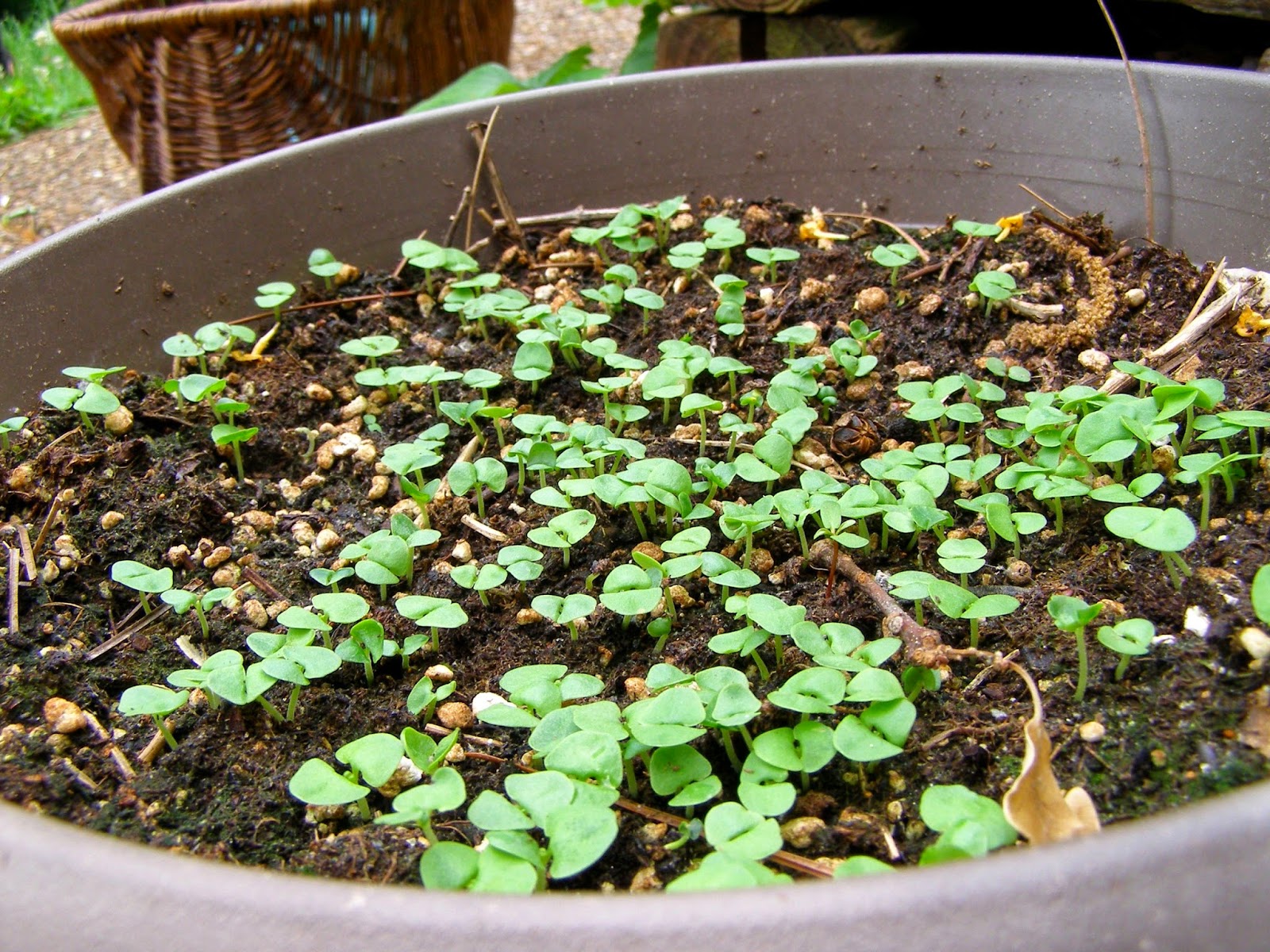
Basil Seedling Nursery
Baby Basil
For the last two years, I've planned to start various herbs, veggies, and flowers throughout the summer, so as to have filler for bare spots as I harvest, and to have lots of sets for fall veggies (which need to be planted in September-ish). I never do it though. In January, making paper pots filled with earth and seed is like planting hope, but in July I don't want to sit at the table...there is too much to do outside. 

So I am starting things in large pots, like the basil above, and will thin them and move them to the garden. I also have some German Chamomile and chives started this way, and plan to keep things growing throughout the summer.

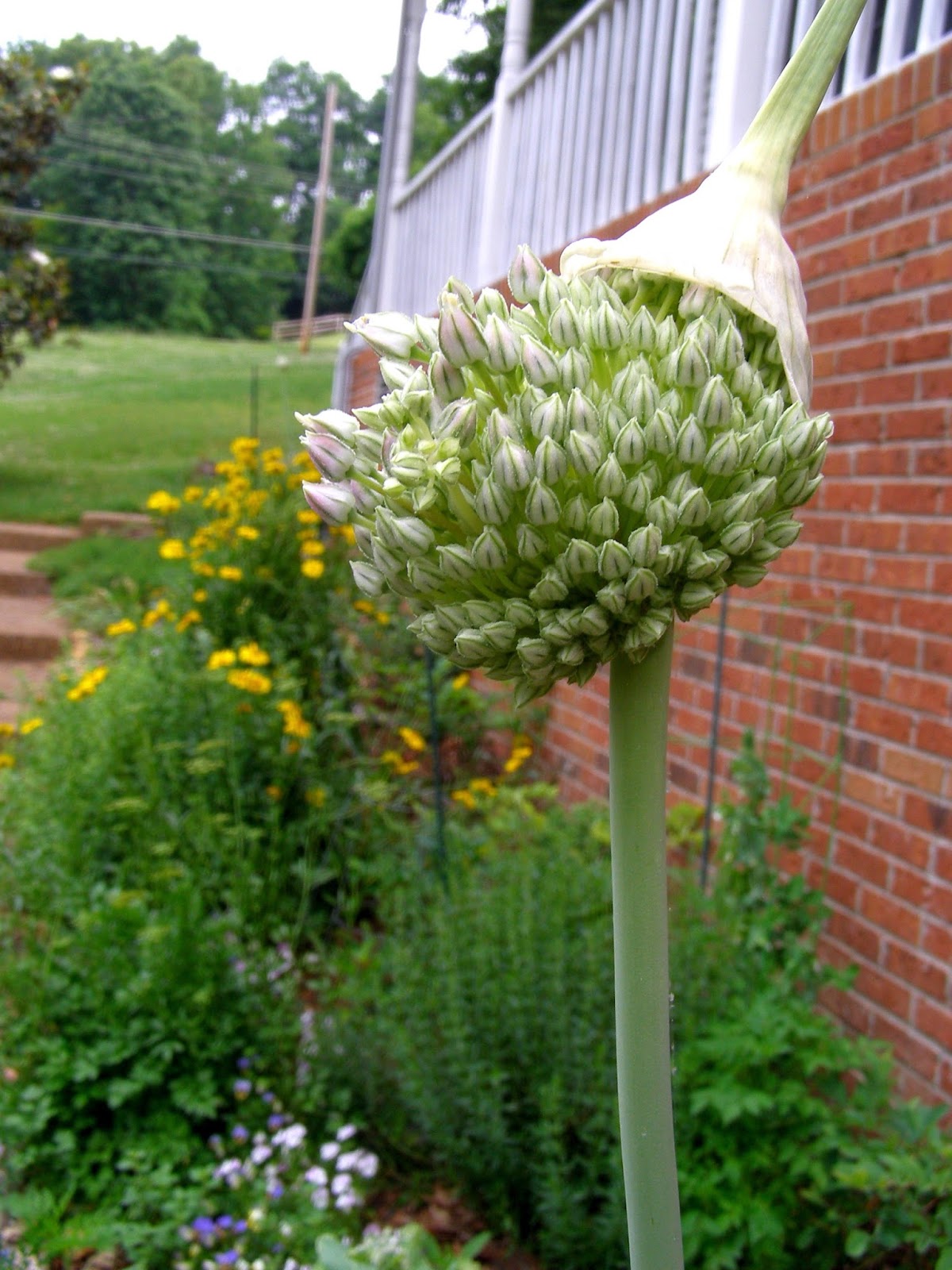
Garlic Flower Hat
Garlic Hat
This is my first year planting garlic. I got some Red Russian seeds from the Seed Sharing program at my local library (how cool is that??), and a few cloves of a different hardneck variety from my father. I am going to try harvesting some seeds from the flower this year. I did cut one of these flowers and fried it up along with some stuffed squash blossoms, and it was delicious! Experiment!

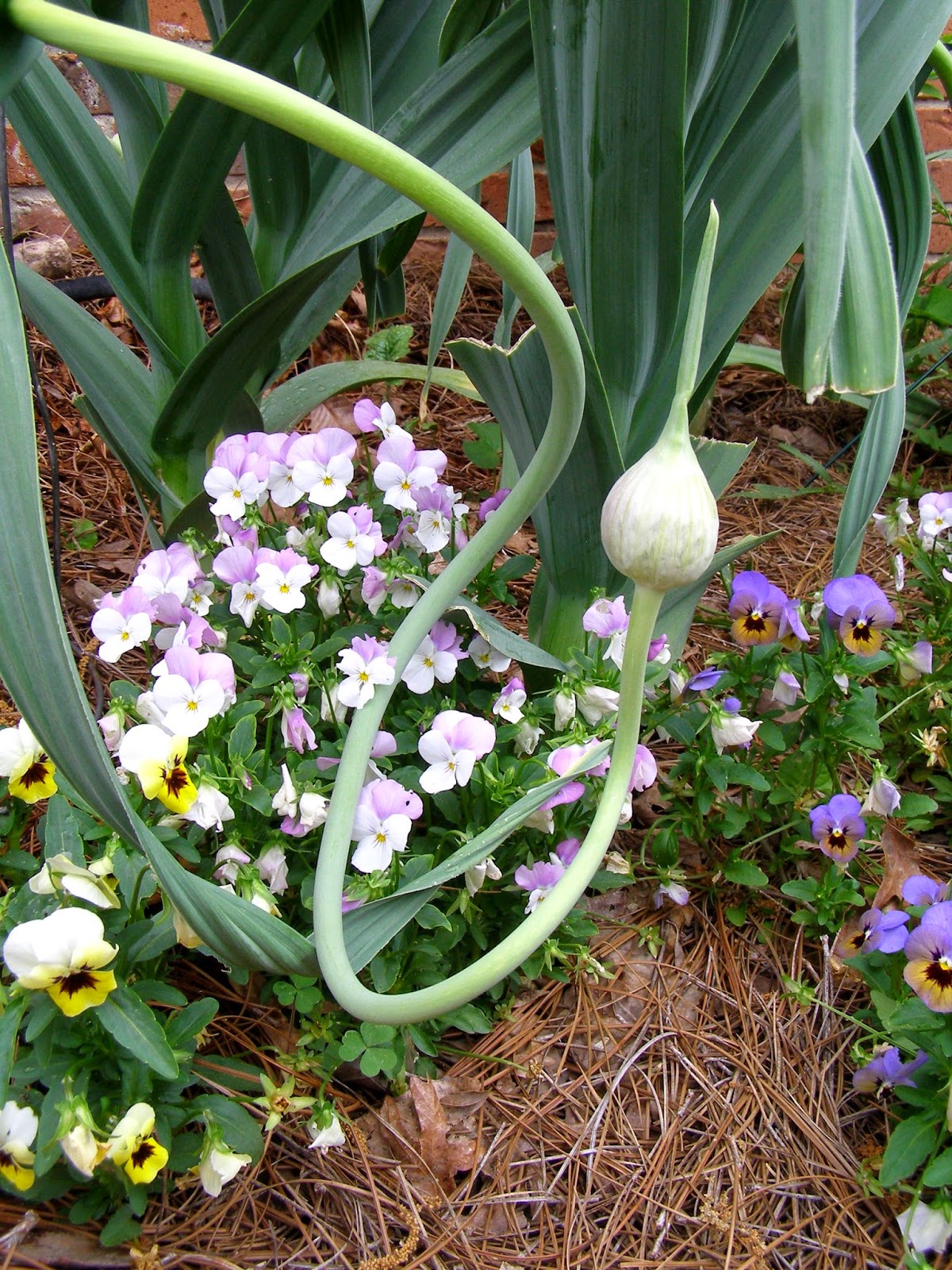
Garlic Scape
Scape
Garlic is a beautiful addition to edible landscaping. The scapes (or long stalks that hold the flower) can curve around into wonderful shapes that are very pleasing to the eye. For hardneck garlic, there seems to be a difference of opinion about whether you should harvest the scapes, or keep them...so I am trying both. All of the garlic plant is edible!! The leaves have a mild garlic flavor, and I add them to pesto. The scapes are also delicious in pesto, but can be grilled/steamed like asparagus! ....or you can leave them to harvest flower seeds.

Corn - Three Sisters
My baby corn is sprouting for my Three Sisters garden!! Wanting space to plant the Three Sisters was the whole inspiration for the sheet mulch project, and it's wonderful to see the life springing from the soil. Traditionally, one plants the corn in little hills 3-4 days before the full moon. While planting, offer prayers of thanks for the elements that make the plants grow (yes, I did this).

When the corn is 4-6 inches tall, I plant the beans, then when that sprouts, I plant the pumpkins. The beans are supported by the corn stalks and replenish the soil (corn is a heavy feeder). The pumpkins shade both, crowd out weeds, and discourage predators. The three also complement each other nutritionally.

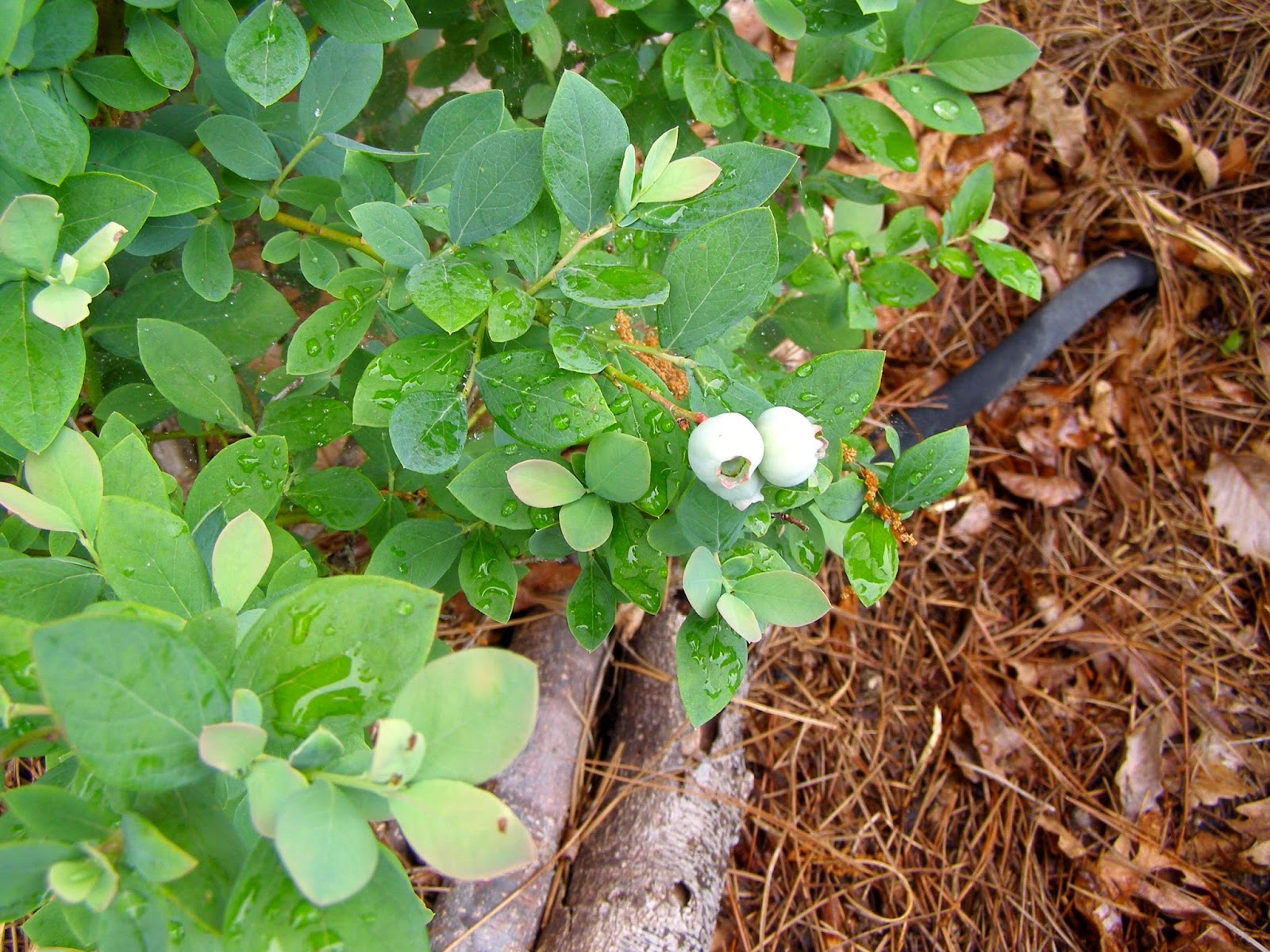
Blueberry
Blueberry
Blueberries are not yet blue, but I am looking forward to eating them. Even when they turn blue, we don't "pick" them -- if you touch them and they don't drop in your hand, they're not quite at their perfect sweetness.

Hyssop
Hyssop
In the Bible, it says "purify me with hyssop, and I shall be clean" but I use my hyssop to attract pollinators, and for cut flowers. It's an excellent companion plant in the garden, and has an attractive "small shrub" shape. I do plan to try some in tea, as WebMD notes it can be helpful for everything from menstrual cramps to cough/cold.

Fig
Fig
The fig lives!! Thank goodness! This fig was propagated by my father, from the large fig tree that grew outside my bedroom window when I was a child. I was working to espalier it against the brick, but the long, cold winter caused it to die back to the ground. The current plan is to "roll with it" and use the dead branch as a trellis of sorts to train the new, flexible branches.

I know that some years it might start where it left off, and some years it might begin anew, and I am okay with that. Plus, then I can string Christmas lights on the branches either way!


Sunday, June 23, 2013

Crock bread falls flat, twice

This Spring, I saw a really intriguing link on my Facebook feed that said "You can cook Bread in your Crock Pot! - It takes less time than the oven because the rising time is included in the Baking."  Despite the weird capitalization, I was intrigued!

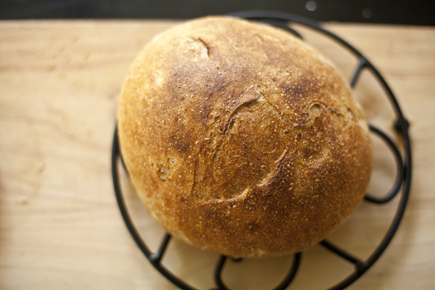
Not my slow-cooker bread
I did a quick web search for "slow cooker bread" since that Facebook page did not include the URL from which the pictures originated (a huge peeve of mine). Thankfully, the blog was easy to find, and you can read the original post here. She uses an artisan bread, which I cook regularly, so I was ready to go.

According to the directions, you place ~1 lb. of dough in your crock pot on parchment and turn it on high. In one hour, you have delicious bread! 

That sounds so simple.....

Here is my dough, ready to go, in my 8-quart slow cooker. I added the lid and turned it to high.
One hour later: the dough flattened (instead of rising) and was gummy and raw. The lid was beginning to take on a lot of moisture, so I cracked it a bit, so as not to soak the loaf. I held out hope.

Two hours later: still not done. I finally pulled it out around the 3-hour mark, and the results were...flat. Here you can see the crock loaf (l) next to one baked in the oven (r).
Despite these bad results, I remained undeterred. Perhaps the 8-quart slow cooker was too big or too hot. I read the comments on the original blog post and decided to try my 1-quart crock instead. A crock uses a lot less energy than an oven, plus no hot kitchen in summer, right? I had to give it another go.

Dough ready to go in my 1-quart crock. Fingers crossed.

Once again, it took several hours to achieve anything approximating "done."
While it did not flatten, due to lack of room in the crock, there was no rising.
Here, the "finished loaf" at 2-ish hours is not terribly appetizing.
Crockpot bread
Second crock loaf (l) is the same height as oven-baked (r), but horridly doughy and dense
due to lack of rise.  The oven loaf spreads a bit, then rises, and has a wonderful texture. I even put the top of the crock-"baked" loaf under the broiler, so it had an even color, but it tasted awful anyway.

 After having zero rise on the second loaf, I decided this method is not for me, unless I get helpful feedback in the comments. The artisan bread takes at most one hour, and I'd rather fire up the oven for a consistent, successful result loved by the whole family than keep trying at the crock.

If you get different results, let me know. If you're only moderately interested in slow-cooker bread, because you want to try something new, I recommend trying instead the Soft 100% Whole Wheat Dinner Rolls from An Oregon Cottage. They are soft and tasty...and I made them without a stand mixer, several times, with consistent, delicious results!

Tag Cloud

Make Your Own simplify Easy garden Inside My Fridge Living on Less recipes food frugal Live Well meal plan Tennessee Edible Landscaping Kitchen Garden organic Garden Tour Spring flowers Real American Food Use It All change vegetables Dinner Grow Your Own grow tomatoes Life Love Summer greens kids Family dinner recipes explore gift seeds Companion Plants Lettuce Reality Sink Saving Seeds bread freezer garlic squash Fall Inspiration Special Try It and See emotion moderation planting quick reduce Art Artisan Bread Beauty CSA Celebrations Cool Beverages Cucumber Experiment Featured Flood Sheet Mulch Small Changes Tea craft fruit reuse soup stock waste yogurt "sometimes food" Amaryllis Becky's Favorite Things Bloody Mary Blueberries Books Cabbage Chard Connections Date Night Edible Flowers Family Dinner Jacob's Ladder Lint No-till Organize Read Real Life TN Native Plant Trash Day Use the Oven Winter black-eyed susan chicken crock pot daily reminder essential oil garden pests kale leftovers permaculture plastic pork potatoes recycle rudbeckia seedling stir-fry strawberries swale trash vegetarian volunteer A-frame Authentic Authentic2 Bacon Baking Fail Better Homemade Body Balm Breakfast Build Soil Butter Carrots Chives Chocolate Milk Chocolate Syrup Christmas Clean Cookbook Review Crock Pot Bread Eat Local Faith Fire Cider Food as Medicine GM foods GMO Ginger HFCS Health Holy Honeysuckle Hot Cocoa Household cleaner Hydrangea Icebox Pickles Iced Mocha Immune Booster Iris Kitchen Sink Lent Life Notes Monsanto Morning Sink My Neighbor's Garden Pickles Placating with Plating PlantEaters Propagating Geraniums Sacred Salvia Leucantha School Lunch Sewing Slow Cooker Bread Slow Cooker Fail Spiderwort Spinach Spiritual Practice Spring roll Sprouts Thanksgiving Time-saving Tips Tincture Turkey Turmeric Victory Garden Vodka Water Kefir What Chefs Feed Their Kids basil bento berm birthday borage brassica broccoli cabbage worm cake canned tomatoes chili coconut compost dessert discipline eggplant eggplant parmesan fennel flour food waste frosting gluten green beans greenhouse grocery healthy hair healthy scalp hornworm hugelkultur icing knead kneading kohlrabi landfill lasagna garden nasturtium natural hair wash no poo pancakes parsley patience pests pizza plantain potager processed sangria seed pot smoothie standing desk substitute for dill tarragon teacher appreciation teacher gift vegan water window crayons yeast

Eat Locally!